C-Suite Guide to AI Scalability Strategies
Scaling AI requires governance, unified infrastructure, and outcome-driven roadmaps to turn pilots into measurable business value.
Apr 29, 2026

C-Suite Guide to AI Scalability Strategies
Scaling AI is about moving from small experiments to fully integrated systems that deliver measurable business results. Many organizations struggle to scale due to fragmented tools, misaligned priorities, and poor data quality. This guide focuses on how leadership can overcome these challenges by building strong governance, clear roadmaps, and scalable infrastructure.
Key Takeaways:
Governance is critical: Tie AI initiatives to business outcomes like revenue growth or cost reduction. Use a tiered risk model for faster implementation.
Phased approach works: Use a 30-60-90 day roadmap to test pilots and scale successful projects.
Unified infrastructure matters: Avoid disconnected tools; build a shared platform with real-time data pipelines.
Leadership and skills: Appoint a Chief AI Officer and upskill teams for AI literacy.
Measure success: Track KPIs like ROI, system reliability, and adoption to ensure AI delivers value.
Scaling AI requires strategic planning, collaboration across teams, and a focus on measurable outcomes. This ensures AI becomes a core operational capability, driving efficiency and growth.
30-60-90 Day AI Scaling Roadmap for C-Suite Leaders
Building a Foundation for AI Scaling
Securing Executive Buy-In and Governance
Executive sponsorship is what turns AI pilots into game-changing strategies tied to core business goals. By 2025, 68% of executives surveyed aim to make their organizations data- and AI-driven enterprises [3]. Yet, many businesses still find themselves stuck in the "pilot phase", unable to scale AI effectively.
The solution lies in connecting AI initiatives directly to key business outcomes - like boosting revenue, cutting costs, or managing risks. Projects tied to these critical metrics are much less likely to drain resources without delivering value.
Early governance is another must-have. A risk-based governance framework ensures transparency and control from the start. Many organizations adopt tiered risk models: low-risk AI applications can proceed quickly within pre-set guidelines, while high-risk projects require stricter oversight, structured approvals, and audit trails to maintain accountability.
"Every company is going to go through this transformation. And now we're getting to the nuts and bolts: How do you re-architect an organization where AI is foundational to how you operate?" - Michelle Page-Rivera, PhD, Managing Director, Slalom [3]
Cross-functional alignment is just as important. A central governance team can set the overarching standards, while individual departments handle execution. This "central policy, federated execution" model ensures consistency without creating unnecessary bottlenecks.
Once executive support and governance are in place, the next step is to implement a phased roadmap to guide AI initiatives toward meaningful results.
Creating a Phased AI Roadmap
With strong governance as the backbone, using proven strategy frameworks provides the structure for successful AI projects. Start by identifying the business outcomes you want to achieve, then set clear KPIs and timelines to measure progress.
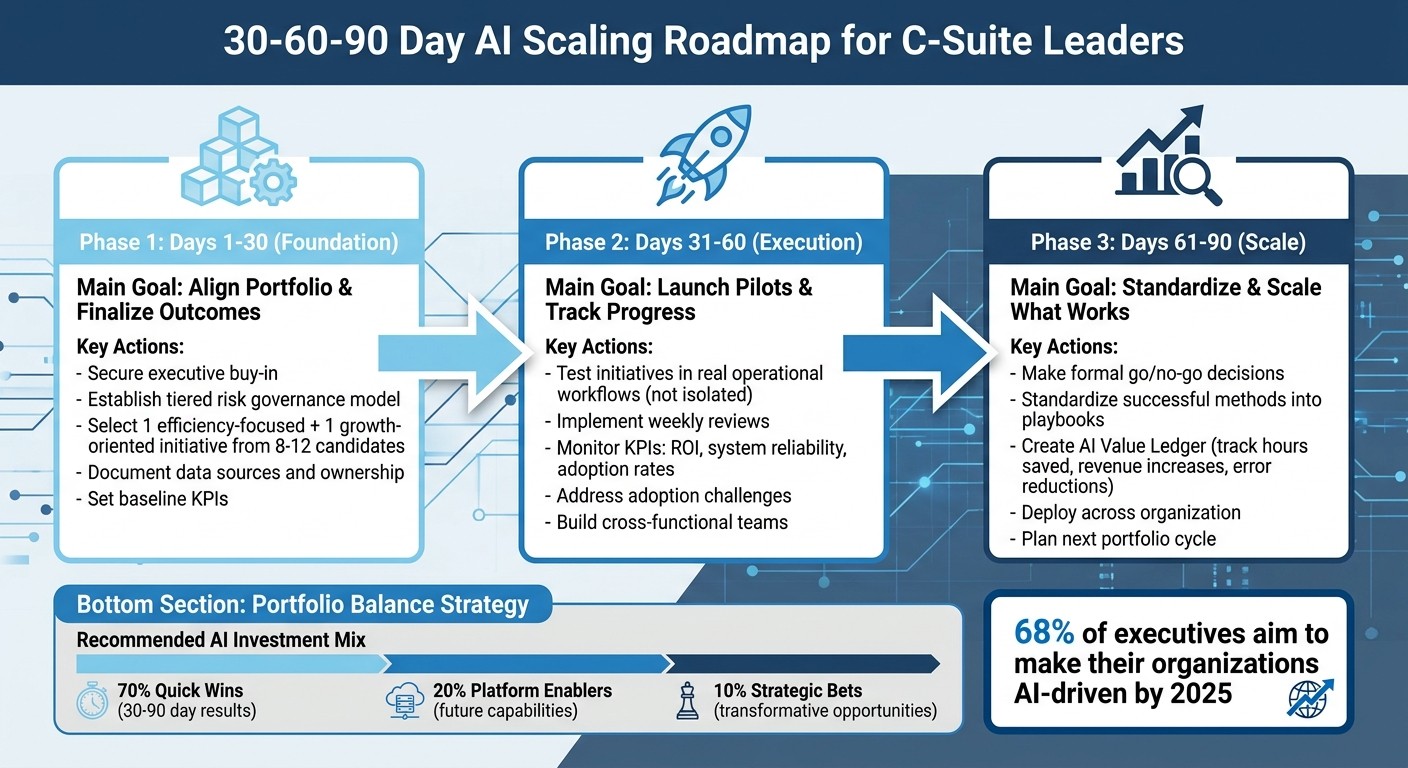
A popular approach is the 30-60-90 day framework. In the first 30 days, finalize your desired outcomes. Over the next 30 days, launch pilot projects and begin tracking KPIs. By day 90, standardize the methods that prove effective.
Prioritization is key, and it starts with a scoring model. Evaluate each use case based on four factors: business impact, time-to-value (aiming for results within 30–90 days), feasibility (especially in terms of data availability), and risk level. This system helps avoid distractions and keeps teams focused on what matters most. A balanced portfolio often includes:
70% quick wins for immediate efficiency.
20% platform enablers to build future capabilities.
10% strategic bets on transformative opportunities.
Before kicking off any use case, document the data sources and clarify who owns them. This process is similar to how AI automates strategic briefs by synthesizing complex data into actionable starting points. If ownership or the "source of truth" isn't clear, the project isn’t ready to move forward. This step helps avoid costly integration issues down the line, especially once budgets and expectations are locked in.
sbb-itb-7250072
Building Scalable AI Infrastructure
Using Cloud and Hybrid Architectures
Once governance and strategic plans are in place, the next step is building a strong infrastructure to scale AI across your organization. Your infrastructure determines whether AI projects remain small pilots or grow into enterprise-wide solutions. Real-time data pipelines are now a must for time-sensitive tasks like dynamic pricing and fraud detection. Consolidating data into a unified data lake or warehouse helps avoid inconsistent model performance caused by fragmented sources [2].
A "central policy + federated execution" model strikes the right balance between standardization and flexibility. Here’s how it works: a small central team sets the standards for infrastructure and security, while individual business units tailor and deploy AI solutions to meet their specific needs [1]. This approach avoids bottlenecks caused by too much centralization while ensuring consistency across the board.
Tool sprawl is a major pitfall to watch out for. Using too many disconnected tools can lead to integration headaches later. Instead, focus on building a unified platform where all AI initiatives share common data, governance rules, and measurement systems [1]. When planning your storage infrastructure, anticipate data growth rates of 5 to 10 times your current volume. This ensures you can handle expanding datasets and model updates without constant overhauls [5].
"Optimizing AI infrastructure isn't about chasing peak performance benchmarks. It's about designing for stability, resiliency, security, and operational clarity as everything scales at once - data, models, environments, and teams." - Mark Menger, Solutions Architect, F5 [4]
By focusing on a unified platform, you create a strong foundation for maintaining data integrity and seamless system integration.
Maintaining Data Quality and System Integration
While scalable architecture is essential, it’s only as good as the quality of the data running through it. Poor data quality undermines even the best AI models. To avoid this, establish clear data lineage, quality controls, and governance frameworks before expanding AI efforts. AI systems should also integrate with existing tools like CRM, ERP, HRIS, and knowledge bases, such as SOPs and policies, to move beyond isolated experiments [1].
To prevent failures, implement a single, consistent access layer for AI workloads rather than relying on direct node connections [4]. For unstructured data, use metadata tagging and real-time search capabilities to maintain clear lineage and ensure quality [6].
Governance needs to be embedded early to avoid compliance risks later. A tiered risk approach works well: low-risk applications can move quickly with automated guardrails, while high-risk AI requires structured approvals and audit logging [1]. Once you identify a successful workflow pattern, turn it into a reusable template to speed up future deployments [1].
Collaborate with your Finance team to create an "AI value ledger." This tool tracks measurable outcomes like hours saved, revenue increases, and error reductions, making it easier to connect infrastructure investments to business results [1].
Scaling AI Without Scaling Risk: The 5 Layers of Governance
Driving Organization-Wide AI Adoption
Once a scalable AI infrastructure is in place, the next step is ensuring the entire organization adopts it effectively. This requires leadership to transform technical capabilities into tangible business outcomes. Just as a phased AI roadmap turns plans into actions, strong leadership ensures those actions lead to measurable results.
Appointing Leadership for AI Initiatives
AI initiatives can’t thrive without clear ownership. Without it, they risk remaining as isolated experiments. To move beyond scattered pilots, appoint a Chief AI Officer or a similar role to take charge. This person’s focus should be on driving outcomes like revenue growth, improving margins, and cutting down cycle times.
A balanced approach works best - one that combines centralized governance with execution at the departmental level. This "central policy + federated execution" model ensures consistency while allowing innovation to flourish without unnecessary red tape [1]. With this structure, the organization can avoid bottlenecks while maintaining alignment across teams.
Cross-functional collaboration is another critical piece of the puzzle. Teams should include a mix of data scientists, engineers, domain experts, compliance officers, and business leaders. This ensures AI solutions are designed to solve practical departmental challenges, rather than existing as purely technical exercises [2]. When leaders across functions view AI as a tool to amplify their team’s capabilities rather than as a burden, adoption tends to happen more naturally.
With this leadership framework in place, the next step is building the skills needed to execute AI strategies effectively.
Building Internal AI Capabilities
Leadership roles alone won’t drive success - teams need the right skills to deliver results. In fact, 69% of executives are already focused on upskilling their workforce for AI [3]. How quickly AI initiatives move from concept to reality often depends on the organization’s overall AI literacy.
Upskilling executives across various functions is essential. A shared understanding of AI concepts helps reduce friction between teams, align priorities, and make scaling decisions easier [1]. Training should focus on practical applications tied to business outcomes, rather than abstract technical theories.
The tiered governance model mentioned earlier also plays a role here. It allows departments to experiment with AI solutions confidently, without worrying about compliance missteps. As Michelle Page-Rivera, PhD, Managing Director at Slalom, explains:
"AI is no longer an opt-in proposition. It's now embedded into nearly every productivity tool that employees regularly access" [3].
Customizing AI for Executive Decision-Making
Standard tools often miss the mark when it comes to executive workflows, frameworks, and decision-making processes. To truly make an impact, AI solutions should be tailored to function as digital teammates, capable of managing entire workflows rather than just automating isolated tasks. By aligning AI systems with the specific decision-making processes of executives, companies can amplify AI's role as a strategic asset.
Applying Proven Frameworks with AI
AI can supercharge established frameworks like customizing SWOT with AI and Porter's Five Forces, allowing a Chief Strategy Officer to perform real-time market analysis and seamlessly integrate findings into strategic plans. To make these insights actionable, connect AI-driven initiatives to outcomes that matter most to leadership - like pipeline coverage, cost-to-serve metrics, or audit readiness. This ensures that AI insights directly align with the metrics CEOs and CFOs rely on for decision-making [1].
Take StratEngineAI (https://stratengineai.com), for example. This platform integrates over 20 strategic frameworks with AI-powered analysis, transforming weeks of consultant work into mere minutes. This efficiency allows leadership to focus on higher-value activities like fostering innovation, building partnerships, and refining differentiation strategies. To guide these efforts, businesses can use prioritization scorecards that evaluate AI use cases based on factors like business impact, time-to-value (30–90 days), data accessibility, risk levels, and potential resistance from stakeholders [1].
Once frameworks are enhanced by AI, the next challenge is to ensure these insights are tailored to the unique demands of different industries.
Adapting AI for Industry-Specific Needs
Industries vary widely in their priorities, requiring AI solutions that address sector-specific challenges. For instance:
Banking executives need AI tools for fraud detection and KYC compliance.
Insurance leaders focus on optimizing claims intake and customer support.
Logistics companies benefit from AI that streamlines route planning and manages fuel costs.
The key lies in pinpointing where critical data resides - whether in CRM systems, ERP platforms, or other systems of record - and ensuring AI has access to this essential information [1][2].
A tiered governance model can help speed up AI deployment. Low-risk applications, like generating market research summaries, can be rolled out quickly with basic safeguards. On the other hand, high-risk applications - such as those influencing pricing or HR decisions - require structured approvals and human oversight. As Ameya Deshmukh from EverWorker puts it:
"The fastest governance model is tiered and explicit: low-risk AI moves fast with guardrails; high-risk AI moves with structured approvals and audit" [1].
To strike a balance between short-term gains and long-term strategy, companies can adopt a 70/20/10 approach for their AI portfolio:
70% on quick wins that deliver efficiency within 30–90 days.
20% on platform enablers to build sustainable capabilities.
10% on strategic projects aimed at gaining a competitive edge [1].
Industry | AI Customization Focus | Key Executive Workflows |
|---|---|---|
Banking | Fraud & Compliance | KYC, payments automation, fraud detection |
Insurance | Claims & Support | Claims intake optimization, call assistance |
Communications | Operations | Self-healing networks, field engineer support |
Utilities | Forecasting & Pricing | Generation forecasting, pricing strategies |
Logistics | Efficiency | Route planning, fuel cost management |
Measuring Success and Improving Over Time
Tracking the impact of AI isn't optional - it’s essential. Without it, organizations are left guessing. Here's a stark reality: 74% of companies have yet to demonstrate measurable value from their AI initiatives, and only 1% of enterprise leaders feel they've successfully integrated AI across multiple core processes [7][9]. To truly succeed, businesses need to move beyond surface-level metrics and focus on indicators that show real results, like productivity improvements. A well-designed measurement system not only proves the value of AI but also guides strategic refinements over time. For more AI strategy insights, explore our latest frameworks and guides.
Setting KPIs for Scalable AI
A strong KPI dashboard should touch on five essential areas: AI models (accuracy), systems (reliability), operations (workflow efficiency), utilization (user adoption), and business value (ROI and innovation) [8]. Keep it simple - seven or eight key metrics are enough to provide actionable insights for executives while avoiding data overload [8]. Different leadership roles will naturally focus on different priorities:
CEOs: Overall ROI and organization-wide productivity changes.
CFOs: Metrics like cost-per-AI-minute and license utilization efficiency, aiming for a sweet spot of 70–85% utilization.
CHROs: Progress in employee training and skills development.
CTOs: Security incident rates and system uptime [7].
"A balanced KPI dashboard covers technical, financial, operational and business measures to form a comprehensive assessment" - Stephen J. Bigelow, Senior Technology Editor at TechTarget [8].
To ensure accuracy, establish baseline metrics within the first 30 days of any pilot program [7]. Research shows AI can deliver an average ROI of 3.7x, with top-performing organizations achieving up to 10x returns [7]. But here's the catch: these returns are only possible if you're measuring the right things. Precision in tracking metrics is the foundation for scaling AI effectively. A structured pilot phase, built on these frameworks, helps accelerate the process.
Testing with Pilots Before Full Deployment
Before scaling AI, a well-structured pilot program is critical. A 30-60-90 day roadmap helps turn strategic plans into actionable, data-driven decisions. Here's how it works:
Days 1–30: Select one efficiency-focused and one growth-oriented initiative from a pool of 8–12 candidates. This prevents the team from spreading efforts too thin.
Days 31–60: Test these initiatives in real operational workflows, not in isolated settings. Weekly reviews help identify and address adoption challenges.
Days 61–90: Make formal go/no-go decisions based on performance metrics. Successful outcomes should be standardized into repeatable playbooks [2].
For example, pilot programs have demonstrated tangible outcomes, such as a 12% reduction in fuel costs. To further strengthen buy-in from key stakeholders like CFOs and board members, consider creating an "AI value ledger." This document tracks measurable gains - such as hours saved, shorter cycle times, or improved conversion rates - and provides a clear, finance-approved record of AI's impact. This kind of transparency makes it easier to secure support for broader deployment.
Conclusion
Scaling AI isn't about chasing every shiny new capability or getting stuck in endless pilot programs. Instead, it's about aligning AI initiatives with clear business goals and building the confidence to move from experimentation to execution. To succeed, organizations need to make three key shifts: transitioning from isolated pilots to a balanced portfolio approach, embedding governance early to manage risks effectively, and fostering an AI workforce that takes ownership of end-to-end outcomes.
The journey starts with aligning AI efforts to measurable outcomes that matter most to leadership - such as growth, improved margins, or reduced risks. This alignment ensures that every initiative ties directly to business value. A structured 30-60-90 day plan can help convert strategy into actionable steps: the first 30 days for aligning the portfolio, the next 30 for executing pilots with clear KPIs, and the final phase for deciding which initiatives to scale [1]. This methodical approach lays the foundation for effective governance and decisive scaling.
"Scaling AI with confidence isn't about chasing every new capability. It's about grounding AI initiatives in strategic business goals." - Ishan, Author, ImmersiveData.ai [2]
Governance must also be a cornerstone of scaling efforts. Using a tiered-risk model allows for faster implementation of low-risk applications while maintaining strict oversight for high-risk ones. Introducing tools like an "AI Value Ledger" - a Finance-approved system tracking metrics like time savings, revenue growth, and error reduction - can help build the trust needed to expand AI initiatives. This reinforces the importance of moving beyond isolated pilots to an integrated AI workforce.
Organizations that treat AI as a strategic operational capability - managing it with the same rigor as any core business function - are the ones that will succeed. Start small, measure progress, and scale what works. This is how AI evolves from a buzzword into a true competitive edge.
FAQs
How do we choose the right AI use cases to scale first?
To make AI work at scale, it’s crucial to target use cases that directly tie into clear business objectives like cutting costs, increasing revenue, or minimizing risks. Focus on high-impact areas - think fraud detection or predictive maintenance - where the results can be both significant and measurable.
Equally important is data readiness. Without a solid data infrastructure and seamless integration, you risk delays and missed opportunities. A strong foundation ensures you can extract value from AI right from the start.
What does a tiered AI risk model look like in practice?
A tiered AI risk model organizes risks based on their potential impact and likelihood, allowing organizations to focus their mitigation efforts where they matter most. For example, high-risk areas - like applications involving sensitive data or those critical to safety - demand stricter oversight and controls. On the other hand, lower-risk projects can operate with greater flexibility.
By setting clear thresholds and governance protocols for each tier, this approach helps strike a balance between managing risks and achieving strategic objectives. It encourages responsible AI use while ensuring resources are allocated efficiently across the organization.
Which KPIs best prove AI value to the CEO and CFO?
To effectively communicate the value of AI to top executives like the CEO and CFO, focus on metrics that tie directly to business outcomes. Here are the key performance indicators to highlight:
AI Usage: Demonstrates how widely and effectively AI tools are being adopted across the organization.
Productivity Impact: Measures improvements in efficiency, such as faster workflows or reduced manual labor, as a result of AI implementation.
Output Quality: Tracks enhancements in the quality or accuracy of products, services, or processes influenced by AI.
Cost Efficiency: Reflects savings achieved by automating tasks, reducing errors, or optimizing resource allocation.
Organizational Readiness: Assesses the company's capability to integrate AI, including employee training, infrastructure, and adaptability.
By focusing on these KPIs, you can clearly connect AI initiatives to the priorities of leadership, showing how they drive measurable results that matter to the business.