Why ChatGPT Can’t Answer the Only Screening Question That Matters: "Should I Interview This Founder?"
AI speeds research and flags issues but can't judge resilience or leadership—use AI for prep, humans for the interview.
May 19, 2026

Why ChatGPT Can’t Answer the Only Screening Question That Matters: "Should I Interview This Founder?"
Investors and consultants face a tough question every week: "Is this founder worth my time?" It’s not just about reviewing pitch decks or data - deciding to meet a founder means judging traits like resilience, leadership, and focus, which AI tools simply can’t measure. While AI speeds up research and handles repetitive tasks like market analysis or document parsing, it struggles with the human side of founder evaluation. Traits like perseverance, team dynamics, and the ability to inspire others don’t appear in data models or pitch decks.
Here’s the key takeaway: AI is a tool, not a replacement for human judgment. It can organize information, flag inconsistencies, and even suggest questions, but the final decision requires human insight. The best approach? Use AI for groundwork and let humans focus on what truly matters - assessing the person behind the pitch.
Why AI Cannot Answer Founder Screening Questions
The Human Traits AI Cannot Reliably Evaluate
Investors are on the lookout for qualities like resilience, coachability, and conviction - traits that only reveal themselves through real-world actions, not through a polished biography or pitch.
For instance, a missionary founder is driven by personal conviction to solve a problem, while a mercenary founder simply identifies a market opportunity. Both might deliver an impressive pitch, but when obstacles arise, the missionary is more likely to persevere. As LvlUp Ventures explains:
"The qualitative signals that separate great investments from good ones - founder resilience, talent magnetism, visceral understanding of customer pain - remain stubbornly human." [3]
One of the most elusive traits for AI to evaluate is talent magnetism - the ability to inspire skilled individuals to join a vision, even at a personal financial sacrifice. This early sign of leadership is critical but entirely invisible to text-based tools.
Structural Weaknesses of Large Language Models in Early-Stage Screening
AI models, built on historical data, excel at recognizing patterns from past successes. However, this strength becomes a liability when it comes to spotting unconventional or emerging opportunities.
"Pattern matching on historical data systematically underweights the best investments... The best human investors are trained to weight exactly these signals." - Trace Cohen, Founder, Value Add VC [2]
This reliance on historical patterns creates a blind spot. Founders tackling uncharted markets or pursuing ideas that seem unconventional by today’s standards often fail to meet AI-generated benchmarks. Consider Airbnb, Amazon, and Pinterest - each was rejected by numerous investors before finding believers, precisely because they didn’t fit the mold [8]. An AI model trained on past "winners" would likely have dismissed them as well.
Another issue is survivorship bias in training data. Many AI models are disproportionately trained on SaaS success stories, leading them to undervalue deep-tech founders, non-traditional backgrounds, and contrarian ideas. Compounding this, AI screening tools have a 30–50% false positive rate when flagging promising startups [9] - a margin too wide for decisions with such high stakes. These limitations underscore why assessing founders requires more than static data analysis.
Why Screening a Founder Is Different from Screening a Pitch Deck
AI’s structural limitations become even clearer when comparing the evaluation of a founder to that of a pitch deck.
A pitch deck is a static document. It captures a business model at a specific moment in time. AI is well-suited for tasks like extracting market size, spotting inconsistencies, or identifying missing sections. These are structured and straightforward tasks that AI handles effectively.
But evaluating a founder is a dynamic and behavioral process. It’s about understanding how someone thinks, adapts, and leads under pressure - qualities that can’t be captured in a document. As Martin Tobias of Incisive Ventures puts it:
"Pre-Seed investing is the lowest information form of investing. ChatGPT is very good at pattern matching in a high-information environment. Pre-Seed is not that. There is just too much judgement involved." [6]
Here’s a comparison that highlights the gap between AI and human judgment:
Evaluation Task | AI Performance | Strengths of Human Judgment |
|---|---|---|
Verifying credentials and traction metrics | Strong | - |
Assessing "rate of learning" and adaptability | Weak | Judges growth trajectory, not just current state |
Analyzing deck clarity and market sizing | Strong | - |
Reading integrity and behavior under pressure | Weak | Detects character through reference calls and live conversation |
Identifying cofounder conflict risk | Weak | Senses team dynamics and psychological safety |
The most critical insights about a founder - how they think, adapt, and lead - are never written down. No document analysis, no matter how advanced, can replace the nuanced understanding gained through live, human evaluation.
sbb-itb-7250072
Where AI Can Help in Founder Screening Workflows
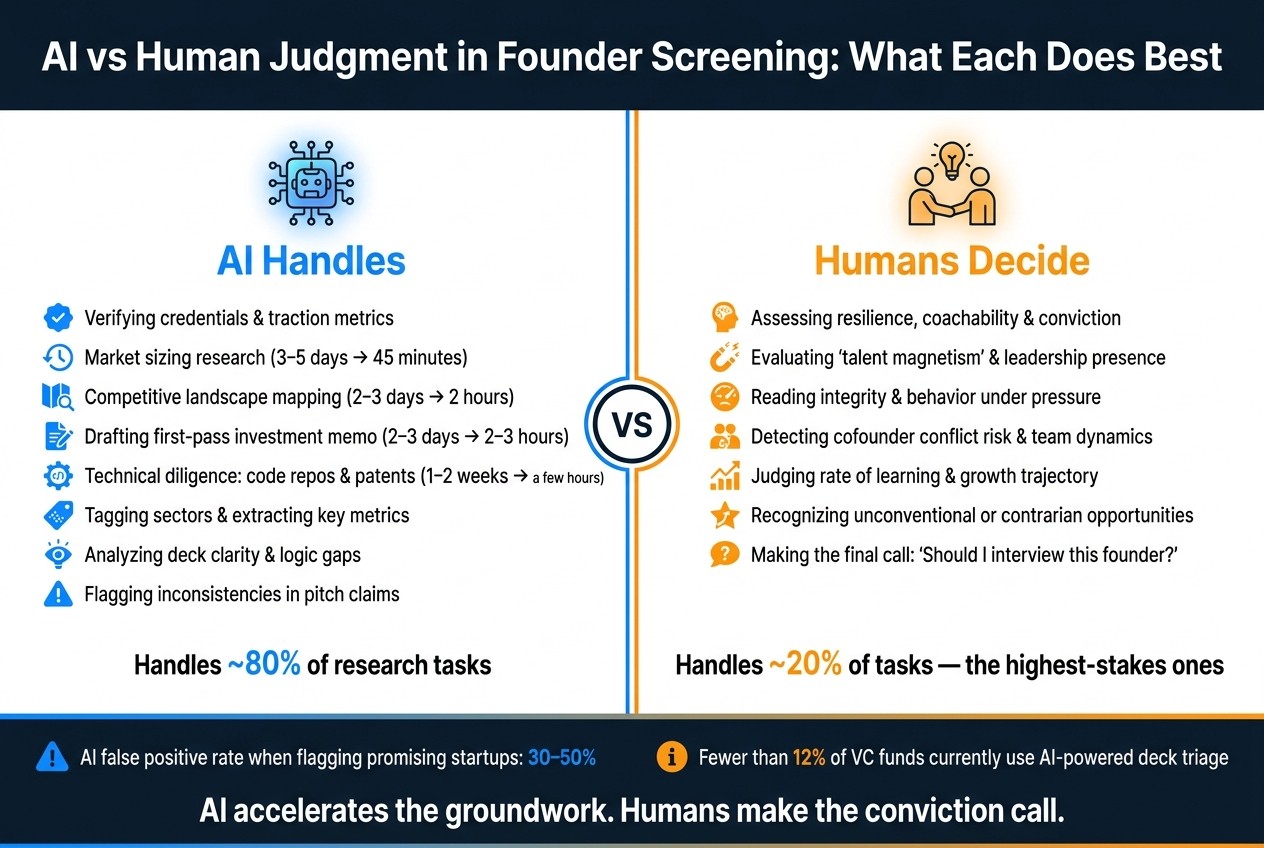
AI vs Human Judgment in Founder Screening: What Each Does Best
Automating Low-Judgment Tasks in the Screening Process
AI shines when it comes to structured, repetitive tasks. In founder screening, this includes tagging sectors, extracting key metrics, verifying funding compatibility, and flagging potential issues. These early-stage, low-judgment activities are where AI thrives.
The time savings are striking: tasks like market sizing research, which used to take 3–5 days, now take just 45 minutes. Mapping competitive landscapes has been reduced from 2–3 days to about 2 hours, and drafting a first-pass investment memo has gone from several days to only 2–3 hours [2]. While speed isn’t the ultimate goal, these efficiencies allow analysts to focus on the high-value, judgment-heavy work that drives investment decisions.
"AI is replacing all three [pattern matching, warm intros, and analyst hours], not by making better decisions but by compressing the cost of getting to a decision." - Trace Cohen, Founder and Investor [2]
By taking over repetitive tasks, AI creates space for deeper, more strategic human contributions.
Using AI to Build Context for Human Decision-Making
Beyond automation, AI plays a critical role in aggregating and organizing data to support more informed decision-making. By pulling from sources like LinkedIn, news articles, GitHub repositories, and patent filings, AI compiles detailed founder profiles in a fraction of the time it would take manually. It can validate pitch deck claims in minutes, cross-referencing market size estimates with existing data. Similarly, technical diligence tasks - like reviewing code repositories or patent filings - have been reduced from 1–2 weeks to just a few hours [2].
In March 2026, Charles Hudson, Managing Partner at Precursor Ventures, introduced Delphi, an AI model trained on his investment memos and talks. Founders used Delphi to refine their updates before meetings, allowing live discussions to focus on strategic issues rather than basic Q&A. Hudson shared:
"The best portfolio check-ins I have are when founders come prepared. With Delphi, they already know my perspective on fundraising and strategy, so our time together goes further." [5]
This approach highlights how AI can enhance human interactions by providing a well-prepared foundation for deeper conversations.
How StratEngine AI Supports AI-Augmented Founder Screening
StratEngine AI exemplifies how AI and human expertise can work together effectively. While AI handles data-heavy research, humans focus on nuanced judgment. This balance ensures that critical decisions remain in human hands.
The platform creates structured investment memos and strategy briefs, leveraging over 20 analytical frameworks like Porter's Five Forces and SWOT analysis. Instead of attempting to assess a founder’s character, StratEngine AI organizes pitch deck information, identifies gaps in logic, and maps findings against established frameworks. The result: a traceable, exportable document that streamlines human review. Tasks that once took days now take hours, freeing up time for the in-depth analysis and discussions that only humans can provide.
"The funds that will lose to AI are not the ones that adopt it too slowly. They are the ones that confuse AI-accelerated research with AI-driven conviction." - Trace Cohen, Value Add VC [2]
AI’s role in founder screening is clear: it handles the groundwork, ensuring that human decision-makers can focus on what they do best - making the tough calls.
A Hybrid Approach: Pairing AI with Human Judgment
Building an AI-Augmented Screening Pipeline
AI excels at processing large volumes of data quickly, but combining it with human expertise allows for a more nuanced evaluation of founder traits. This hybrid approach splits the screening process into two key phases: AI-driven research and human judgment.
In practice, about 80% of research tasks - like market sizing, competitive analysis, document parsing, and aligning with investment theses - are handled by AI. The remaining 20% focuses on tasks requiring human insight, such as building relationships and recognizing subtle patterns that AI might miss [7][2].
To make this approach work, it's crucial to give AI a clear framework. Start by codifying your investment thesis into a structured decision model, outlining your focus areas, preferred sectors, and key founder traits. Without this anchor, AI outputs can become overly generic or unreliable.
Adopting AI in stages helps teams adjust. Begin by using AI for simpler tasks like sourcing, and gradually expand its role as the team gains confidence in its capabilities. This phased approach ensures the tool is well-calibrated before it's applied to more complex decisions.
With this foundation in place, AI insights can be turned into actionable interview strategies.
Turning AI Analysis Into Sharper Interview Questions
One practical yet often overlooked use of AI in screening is generating targeted interview questions. For example, if AI flags an unsupported claim in a pitch deck - like a market size estimate without a cited source - you can turn that into a direct question for the founder. Similarly, if AI highlights that a founding team has limited experience working together, it can prompt deeper discussions about team dynamics.
AI can also help craft scenario-based questions to explore potential risks. For instance, you might ask: How would you adjust if your next funding round falls 30% short of your target? What’s your plan if a well-funded competitor launches a similar product next quarter? [1].
Prompts like "highlight areas where you’re inferring rather than observing" can also help uncover gaps for human interviewers to explore further [7].
Setting Limits to Avoid Over-Reliance on AI
Even the best AI systems have limitations. Models trained on historical deal data might undervalue unconventional or groundbreaking investments that deviate from past trends. This could unfairly penalize founders working in emerging or less-established categories [2][9]. A low score might not reflect a lack of potential but rather a lack of comparable examples.
To counteract this, implement safeguards to ensure decisions remain balanced and fair. Always cross-check AI findings with credible sources. Use a consistent scoring framework, and document how AI contributes to each decision to avoid unintended biases [7][1].
This approach reflects the article's central idea: AI should enhance, not replace, human judgment in the founder screening process.
"The future of seed investing isn't AI replacing judgment. It's AI making great investors dramatically more effective." – LvlUp Ventures [3]
Conclusion: Rethinking Founder Screening in an AI-Driven Era
What This Means for Venture and Consulting Workflows
The sheer volume of startups that venture capital (VC) firms evaluate makes AI a game-changer. Top-tier funds typically review around 1,000 to 1,500 companies annually but invest in fewer than 10. Mid-sized seed funds handle even more - up to 5,000 applications a year [2][3]. Reviewing every pitch deck manually? Simply not practical.
This is where AI steps in. It can reduce the time it takes to create a first-pass investment memo from 2–3 days of analyst work to just 2–3 hours [2]. For boutique firms, this means greater efficiency without compromising the depth of analysis. Despite these benefits, fewer than 12% of institutional VC funds currently use AI-powered deck triage systems [4]. Early adopters of these tools can gain a significant edge.
Keeping Humans at the Center of High‑Stakes Screening Decisions
AI may speed up data analysis, but the ultimate decision-making remains a human responsibility.
The key question - "Should I interview this founder?" - isn't purely about data. It’s a matter of judgment. While AI excels at analyzing metrics like market size, it struggles to evaluate the intangible qualities that define great founders. Traits like resilience, a clear sense of mission, and the ability to attract top talent often don’t emerge in pitch decks or AI-generated summaries.
"Reserve human conviction for the decisive moments where the data says no but the pattern says yes." – Trace Cohen, Builder, Value Add VC [2]
As AI continues to accelerate the screening process, the real challenge lies in ensuring that critical decisions stay firmly in human hands. By combining AI's speed with human intuition, firms can maintain a workflow that is both efficient and adaptable to the complexities of investment decisions.
FAQs
What founder signals can’t be captured in a pitch deck?
Pitch decks often overlook essential human qualities that play a key role in a founder's success. Traits like judgment, resilience, integrity, coachability, and leadership style are difficult to capture in slides. These characteristics are best evaluated through face-to-face interactions, behavioral observations, and how individuals perform in real-world situations.
Moreover, abilities such as managing pressure, responding to feedback, and maintaining a consistent narrative tend to reveal themselves over time. Assessing these requires human insight and the ability to recognize patterns - something AI tools, on their own, can't fully achieve.
How do I use AI without letting it decide who gets a meeting?
AI can simplify the founder screening process by handling tasks like reviewing pitch decks and spotting key indicators such as prior experience, team collaboration, and market momentum. That said, human judgment must still play the central role, especially for evaluating complex qualities like vision and leadership. Use AI to sort and rank potential candidates, but let human insight guide the final decisions to ensure the subjective, critical elements of founder evaluation are not overlooked.
What interview questions best reveal resilience and adaptability?
When evaluating resilience, consider asking: "Can you share a significant challenge you faced and how you handled it?" This question sheds light on someone's ability to navigate setbacks and persevere through difficulties.
To gauge adaptability, try: "Describe a time you had to pivot your strategy - what was the outcome?" This helps uncover how well someone responds to change and adjusts to evolving circumstances.
Both questions provide valuable insights into traits like perseverance, flexibility, and the capacity to thrive in dynamic situations.