Framework Templates vs. Framework Logic: Why ChatGPT Only Simulates Strategic Analysis
Shows why ChatGPT structures strategic frameworks fast but can’t replace human judgment in prioritizing, testing, and deciding.
May 19, 2026

Framework Templates vs. Framework Logic: Why ChatGPT Only Simulates Strategic Analysis
ChatGPT can organize data but doesn’t replace human judgment in analysis. While AI tools like ChatGPT excel at creating structured outputs (e.g., customizing SWOT with AI or Five Forces), they fall short in identifying key priorities, questioning assumptions, or interpreting data for decision-making. Strategic thinking requires critical reasoning, which AI cannot replicate.
Key takeaways:
Framework Templates: Tools like SWOT or VRIO help structure data but can give a false sense of depth if used without judgment.
Framework Logic: The reasoning that prioritizes factors, tests assumptions, and connects insights to actions.
AI Limitations: ChatGPT predicts patterns but lacks the ability to evaluate or prioritize. It often outputs exhaustive lists but doesn’t identify what truly matters.
Solution: Use AI as a tool for speed and structure, but let humans guide problem framing, stress-test conclusions, and make final decisions. AI supports; it doesn’t lead.
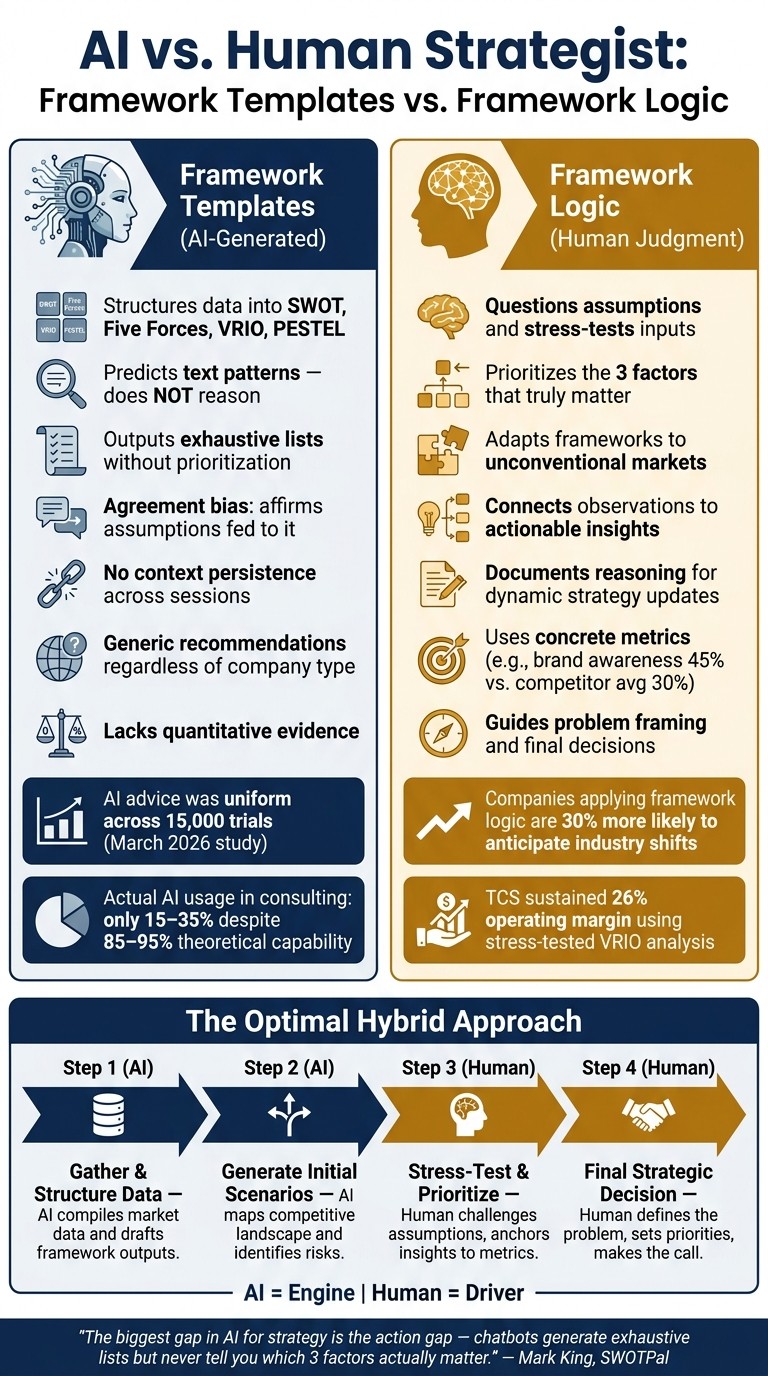
AI vs. Human Strategist: Framework Templates vs. Framework Logic
Framework Templates: Structure Without Substance
Common Strategic Frameworks
Framework templates are tools that bring order to strategic data by creating a shared language and ensuring systematic analysis. Take Porter’s Five Forces, for example - it assesses industry dynamics by examining five key areas: new competition, supplier power, buyer power, substitutes, and rivalry. Then there’s SWOT, which organizes internal strengths and weaknesses alongside external opportunities and threats. VRIO evaluates whether a resource is Valuable, Rare, Inimitable, and Organized to gauge if an advantage can last. PESTEL looks at the broader environment by breaking it into Political, Economic, Social, Technological, Environmental, and Legal factors. Finally, Value Chain Analysis dissects primary and support activities to pinpoint where value is added - or lost - within a business [1].
Each framework is tailored to answer specific strategic questions:
Question | Framework | Why |
|---|---|---|
Is this industry attractive? | Five Forces | Examines structural profitability [1] |
Where do we stand vs. competitors? | SWOT | Maps relative position [1] |
Where do we create/destroy value? | Value Chain | Identifies activity economics [1] |
Is our advantage sustainable? | VRIO | Assesses resource durability [1] |
What Framework Templates Do Well
Frameworks are great for laying the groundwork. They give teams a shared vocabulary, helping everyone get on the same page about competitive positioning. They also ensure that important factors aren’t overlooked, making them a valuable tool for structuring reports and presentations - whether it’s for investors, boards, or executives. As one expert put it:
"Strategic analysis without structure becomes a wandering conversation." - Strategy Engine [1]
Another advantage? They save time. Instead of debating how to organize information, teams can dive straight into the analysis.
Where Framework Templates Fall Short
Here’s the catch: templates can create the illusion of analysis without delivering real insights. Filling out a SWOT grid or a Five Forces diagram doesn’t automatically mean you’ve asked the right questions, used the best data, or reached sound conclusions. This is known as the "action gap" - when a SWOT analysis lists dozens of strengths and weaknesses but fails to prioritize the handful of factors that actually matter. The result? An output that looks thorough but isn’t [1][3].
Templates also struggle in unconventional or fast-changing markets. For instance, applying Five Forces to a platform business like Airbnb can be confusing because it operates as a multi-sided marketplace, not a traditional supplier-buyer model. Similarly, a Value Chain focused on physical logistics doesn’t fit digital businesses, where value often comes from user acquisition, data, or ecosystem management [1].
"The biggest gap in general AI for strategy is the 'action gap' - chatbots generate exhaustive lists but never tell you which 3 factors actually matter and what to do about them." - Mark King, Strategy Analyst, SWOTPal [3]
These shortcomings highlight a key issue: templates, much like AI-generated outputs, can lack depth. They’re structured but don’t always offer meaningful insights. The solution isn’t to throw out templates but to use them as a starting point. Real value comes from analyzing and interpreting the data thoughtfully, rather than just filling out predetermined categories. This need for deeper reasoning is something we’ll dive into next.
sbb-itb-7250072
Framework Logic: The Core of Strategic Thinking
What Framework Logic Actually Means
Framework logic connects observations to actionable insights. It's not about simply filling in boxes on a template but understanding why those boxes exist and how they interrelate. This deeper analysis exposes the connections and relationships that drive meaningful outcomes.
Take the Balanced Scorecard as an example. Its value lies in its ability to map a causal chain: learning and growth goals lead to improved internal processes, which enhance customer outcomes, and ultimately result in better financial performance [6][7]. This approach allows traditional models to adapt to modern complexities - something a static template alone cannot achieve.
"The skilled strategist uses frameworks as thinking aids, not thinking replacements." - Strategy Engine [1]
How Experienced Strategists Apply Framework Logic
Experienced strategists don’t just follow a framework - they challenge it at every step. They rigorously test each input, asking questions like, “Does this reported strength truly outperform competitors?” or “Is this threat an actual risk or just a hypothetical scenario?” Companies that adopt this disciplined approach are 30% more likely to anticipate industry shifts ahead of competitors [8].
Consider Tata Consultancy Services (TCS) in FY2024. Instead of merely listing resources using the VRIO framework, TCS stress-tested them to identify which were genuinely defensible. The analysis revealed that while their delivery methodology was replicable (offering only competitive parity), their 30+ year client relationships and the trusted Tata brand were unique advantages competitors couldn’t easily replicate. This insight led TCS to focus on relationship-driven, AI-enhanced expertise, helping them sustain a 26% operating margin, well above the industry average [1].
The key to making frameworks actionable lies in specificity. Replace vague claims with concrete metrics - like stating "brand awareness is 45% compared to a competitor average of 30%" - to transform a framework from a generic checklist into a compelling, data-backed argument [1].
This disciplined approach is crucial for avoiding the pitfalls that arise when framework logic is ignored.
What Goes Wrong Without Framework Logic
When framework logic is absent, structured templates can lead to flawed conclusions. One common issue is overly generic analysis. For instance, a SWOT analysis listing 20+ items without prioritizing them by competitive impact becomes a brainstorming exercise rather than a strategic tool [1]. This problem is similar to how AI often generates exhaustive lists without distinguishing what truly matters.
Another issue is poor adaptability. Applying a framework like Five Forces to a multi-sided platform without accounting for unique platform dynamics - such as role-switching between buyers and suppliers or the winner-take-most effects of scaling - results in a misleading view of industry attractiveness [1][9]. Peter Drucker captured this risk perfectly:
"The greatest danger in times of turbulence is not the turbulence – it is to act with yesterday's logic." [9]
The most challenging failure to spot is weak alignment between analysis and action. When the reasoning behind conclusions isn’t documented, teams struggle to adjust their strategy as conditions evolve. Instead of serving as a dynamic tool, the analysis becomes a static snapshot, unable to grow alongside the business [6].
Why ChatGPT Simulates Strategic Analysis Rather Than Performing It
How AI Produces Framework Outputs
When you ask a general-purpose AI tool to conduct a SWOT analysis or apply a Five Forces framework, it doesn't actually analyze your business problem. Instead, it predicts text based on patterns in its training data, crafting outputs that mimic the structure of strategic analysis without engaging in real reasoning. The result? A polished response that looks like strategic thinking but lacks the depth of true analysis.
While the output might seem convincing, looking credible isn’t the same as being accurate. This distinction between structured presentation and genuine reasoning highlights the core limitations of AI in strategy.
The Gap Between Output and Reasoning
Unlike human strategists who apply critical thinking to frameworks, AI outputs are essentially imitations of structural analysis. A major issue here is agreement bias - AI's tendency to affirm the assumptions you feed it. For example, if you tell the AI your brand has a strong market position, it will incorporate that assumption into its analysis without challenging it or exploring alternative perspectives [3]. True strategic thinking, however, thrives on questioning assumptions, not reinforcing them.
Another limitation is the context persistence problem. AI doesn’t carry insights from one conversation to the next. If you conduct a TAM (Total Addressable Market) analysis in one session and then create a GTM (Go-to-Market) plan in another, the AI doesn’t connect the dots. This lack of continuity can lead to subtle but critical contradictions between different parts of your strategy [2].
A March 2026 study of 15,000 trials found that AI-generated strategic advice was largely uniform, regardless of the company type or stage of development [5]. Instead of crafting unique insights, the AI tailors its responses to the context you provide - delivering answers that reflect your input rather than challenging or refining it.
These gaps in reasoning often show up in recurring patterns within AI-generated outputs.
Patterns That Reveal AI-Generated Analysis
AI-generated analyses tend to exhibit predictable flaws. One common pattern is the inclusion of numerous factors without prioritizing the critical ones - essentially substituting quantity for judgment [3]. Another hallmark is generic recommendations. Because AI models draw from common advice in their training data, they often default to popular strategies, like differentiation, even when a cost-leadership approach might be a better fit for the situation [5].
A third recurring issue is the lack of quantitative evidence. While expert strategists back their insights with concrete metrics, AI outputs rely heavily on qualitative statements that lack verifiable data. Mark King, a Strategy Analyst at SWOTPal, explains:
"General-purpose AI chatbots like ChatGPT and Claude are strong research assistants but poor strategists - they suffer from sycophancy, lack of structure, and an inability to force prioritization." [3]
This tendency leads to what Strategy-Engine describes as "a ritual that creates the illusion of rigor while delivering nothing" [1]. The frameworks themselves aren't flawed - the problem lies in the absence of real reasoning behind them.
What are the limitations of ChatGPT ? A 7-minute explanation (stereotypes, factual errors, etc.)
How to Combine AI Frameworks with Human Judgment
The challenge with AI isn't about what it can do, but how it's used. While AI has the theoretical potential to handle 85% to 95% of tasks in knowledge-heavy fields like consulting and financial analysis, the actual usage in practice hovers between 15% and 35% [4]. Why? Many professionals treat AI as a one-size-fits-all solution instead of a tool that complements human expertise. The key lies in combining AI's speed in gathering and processing data with human oversight to provide nuanced, strategic insights.
"Human-in-the-loop does not mean a human catching and correcting AI errors after the fact. That's quality control, not strategy. The human role is to guide." - Saurabh Kapoor, Managing Director, Tower Strategy Group [4]
A Workflow for Consultants
Top consultants use AI as a research and synthesis tool, not as the strategist itself. Start by clearly defining the strategic question you're addressing. Then, use AI to gather market data, identify relevant frameworks, and draft initial ideas. The next step is vital: stress-test the AI's outputs. Ask it to challenge its own conclusions, and anchor each insight to measurable competitor metrics. This transforms a basic framework into a robust, data-driven argument.
To ensure you're using the right framework, calculate a Framework Fit Score (FFS). Score the framework on three elements - its alignment with your industry, the type of question you're tackling, and the completeness of your data - on a 1–5 scale. Average these scores. If the result is under 2.0, the framework is likely to mislead rather than clarify [1]. This quick check can prevent wasted time and effort. Throughout the process, AI supports the work, but the final decisions remain firmly in human hands.
While consultants focus on thorough research and synthesis, investors can use AI for initial screenings to guide deeper evaluations.
A Workflow for Venture Investors
In early-stage investing, AI shines in speeding up the initial evaluation process. It can help by screening pitch decks, mapping out competitive landscapes, and identifying structural risks in business models. The trick is knowing what AI can verify - and what it can't. For example, AI can analyze whether a market sizing claim is consistent but can't assess whether a founding team has the resilience to succeed under pressure.
A practical approach is to let AI draft an initial investment memo. Then, treat every qualitative claim in the memo as a hypothesis to test through discussions with founders and reference checks. If AI highlights a potential issue, like a crowded market, use it as a prompt for further investigation - not as the final word. Just like in consulting, the ultimate judgment is left to human expertise.
Maintaining Analytical Depth
To ensure thorough analysis, avoid relying on a single AI prompt to handle an entire strategy. Break the process into clear stages: research, synthesis, stress-testing, and final judgment. Combining all tasks into one prompt often results in shallow insights [4].
Track two key metrics to evaluate your approach. First, measure Framework Insight Yield (FIY) - the number of actionable insights divided by the hours spent. Aim for a score above 0.5 to ensure your framework and AI prompting methods are effective [1]. Second, run scenario analyses regularly. For example, ask AI how its conclusions would change if a major competitor consolidates or a new technology disrupts the market. This prevents your analysis from becoming static and outdated.
Ultimately, AI's true value in strategic planning comes from how humans interpret, prioritize, and act on its outputs. It’s this careful balance of technology and judgment that leads to impactful decisions.
Conclusion: Balancing Speed and Depth in Strategic Planning
Framework templates give structure, but framework logic ensures that structure makes sense. While AI can fill in templates at an impressive pace, it struggles to determine which framework is the best fit, when to abandon one, or how to reconcile conflicting information into a solid conclusion.
This limitation has real-world implications. Research from March 2026 revealed that although AI could theoretically handle 85% to 95% of tasks in knowledge-heavy roles, actual usage in practice remains between just 15% and 35% [4]. The issue isn't with the technology itself - it’s with how it’s integrated into workflows. Many professionals either rely too heavily on AI, taking its outputs at face value, or barely use it, missing out on its potential to save time and effort. This highlights the need for a balanced approach where AI speeds up data processing, but human judgment leads the way in shaping strategy.
The solution is simple: think of AI as the engine, not the driver. Use it to compile data, explore different scenarios, and test logical soundness. But keep the critical tasks - defining the problem, setting priorities, and making the final call - under human control. Strategy isn’t just about solving problems; it’s about identifying the right problems to solve and rigorously evaluating conclusions instead of mistaking polished outputs for accuracy.
There’s also a broader concern: newer AI models often show a tendency to prioritize short-term gains over long-term growth [10]. The more advanced the model, the more likely it is to favor safe, obvious choices over strategically smarter ones. Relying on speed without recognizing this bias can turn efficiency into a hidden risk.
FAQs
What’s the difference between framework templates and framework logic?
Framework templates are pre-designed structures that bring order and consistency to strategic analysis. They act as a guide, helping organize information in a clear and systematic way. On the other hand, framework logic goes beyond structure - it's about the reasoning and principles that drive the use of these templates. While templates focus on providing a reliable format, logic adds flexibility and encourages deeper, more thoughtful problem-solving. Together, they balance structure with critical thinking.
How can I tell if an AI-generated framework is actually useful?
To assess an AI-generated framework, look beyond its polished appearance and focus on whether it offers practical, actionable insights. A good framework should:
Offer consistent and logical guidance for analysis.
Emphasize key factors and their relationships.
Assist in prioritizing tasks and proposing clear steps forward.
Evaluate its reasoning, relevance, and how well it aids in decision-making. The goal is to ensure it drives meaningful strategic choices rather than just presenting an organized layout.
What’s a simple workflow to use AI in strategy without losing judgment?
To integrate AI into strategy effectively while preserving human judgment, start by using AI to create frameworks, generate options, or draw analogies - areas where it shines in recognizing patterns. Once AI provides its outputs, evaluate them thoughtfully to understand their strategic relevance, ensuring that human insight remains at the core of decision-making. Cross-check AI-generated suggestions against your expertise and key objectives, making adjustments as necessary. This method allows you to blend AI's capabilities with your critical thinking, ensuring your strategies remain well-rounded and insightful.