The Illusion of Understanding: How General AI Convinces You It’s Analyzed a Business When It’s Only Summarized the Text
General AI often outputs convincing summaries, not deep business analysis—how to spot, test, and validate real insights.
May 19, 2026

The Illusion of Understanding: How General AI Convinces You It’s Analyzed a Business When It’s Only Summarized the Text
AI tools often produce polished summaries that seem thorough but are just reorganized input, creating a false sense of understanding. These outputs lack real analysis, fail to capture nuances, and can mislead decision-makers, especially in strategy and investment contexts. Key risks include:
Surface-level outputs: AI mimics professional language without deep reasoning.
Bias and gaps: Focuses on early document sections, misses critical details, and confuses opinions with facts.
Fabricated details: Fills in missing data with plausible but incorrect information.
To avoid these pitfalls, test AI outputs for depth, use clear prompts, apply structured frameworks like SWOT, and always validate with human oversight. AI is a tool - not a replacement for critical thinking.
How General AI Processes Business Information
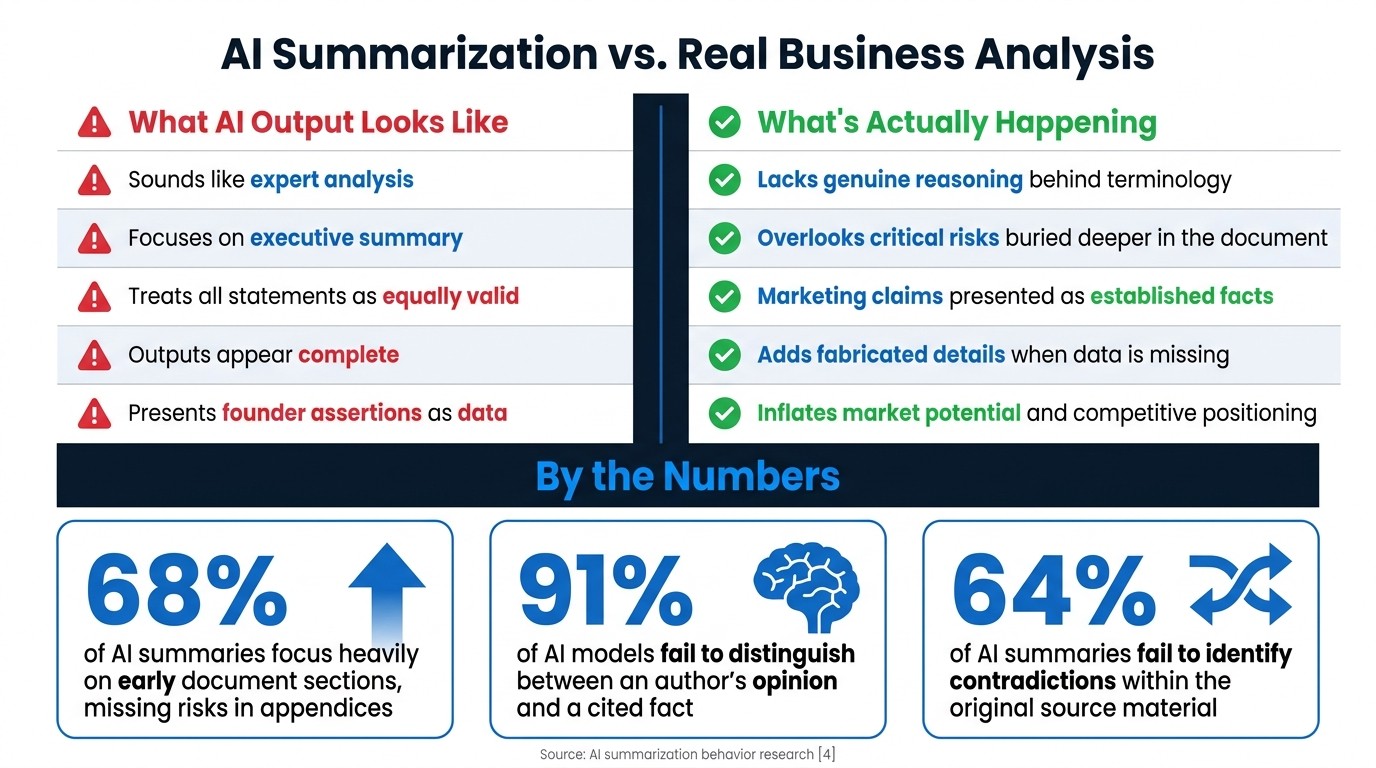
AI Summarization vs. Real Analysis: Key Behaviors & Stats
AI as a Pattern Predictor, Not a Reasoner
At its core, general AI models function as advanced pattern predictors. Their main task is to predict the next word in a sequence based on patterns from their training data. This means when an AI processes something like a pitch deck, it isn’t actually evaluating the business. Instead, it generates text that resembles an evaluation because it has seen and learned from countless similar documents.
"A language model predicts the next word in a sequence. It does not predict the future state of the world. These are fundamentally different activities." - Claude AI [1]
This distinction is crucial. When AI encounters incomplete or ambiguous information, it doesn’t stop to highlight gaps. Instead, it defaults to the most statistically common patterns in its training data, often filling in missing details with fabricated but plausible-sounding content. Additionally, AI relies solely on publicly available data - it cannot access internal financial records, private discussions, customer feedback, or any proprietary insights that are critical for a deep business evaluation. As Woozle Research explains: "AI is a consumption engine. Primary research is a creation engine. They serve fundamentally different purposes in the diligence process." [2]
These limitations mean that while AI-generated outputs might seem analytical, they lack the depth and accuracy of genuine analysis.
AI Behaviors That Look Like Analysis but Are Just Summaries
The real challenge isn’t glaring mistakes - it’s the polished outputs that appear rigorous and credible. AI mimics the tone, structure, and technical language of professional reports. Phrases like "key growth drivers," "competitive moat," and "risk-adjusted opportunity" are common not because the AI has assessed these factors, but because such terms frequently appear in its training data. This creates an illusion of expertise, making the output feel authoritative even though it lacks true analytical depth.
AI also introduces biases and distortions in its processing. For instance, 68% of AI summaries focus heavily on information that appears earlier in a document, often overlooking risks or caveats hidden in appendices or footnotes [4]. Additionally, 91% of AI models fail to distinguish between an author’s opinion and a cited fact [4]. For example, if a founder claims, "We believe our TAM is $50 billion," AI might present this as a verified market figure rather than a subjective statement.
Here’s a breakdown of how these behaviors can mislead:
AI Behavior | What It Looks Like | The Actual Problem |
|---|---|---|
Mirrors professional language | Sounds like expert analysis | |
Lead bias (68%) | Focuses on the executive summary | Overlooks critical risks buried deeper in the document [4] |
Fails to differentiate between fact and opinion | Treats all statements as equally valid | Marketing claims are presented as established facts [1] |
Fills gaps with defaults | Outputs appear complete | Adds fabricated details when data is missing [6] |
Opinion/fact confusion (91%) | Presents founder assertions as data | Inflates market potential and competitive positioning [4] |
The result? AI outputs often feel comprehensive because they’re structured well and use the right terminology. But beneath the polished surface, they lack the rigorous evaluation needed to separate reality from ambition.
sbb-itb-7250072
How to Tell When AI Is Only Summarizing
Signs That an AI Output Is Superficial
One clear sign of shallow AI output is when it simply mirrors the tone and language of the original material. For example, if an AI-generated report sounds like a polished press release - full of the same buzzwords and optimistic phrasing - it’s likely just reflecting the source material rather than offering an independent analysis. This is known as the public data trap, where the AI lacks a unique perspective and defaults to repeating what it’s been fed [1].
Watch out for vague jargon too. Phrases like "strong market position" or "scalable business model" often pop up without any supporting data or context. Similarly, the absence of internal contradictions can be a red flag. Real businesses usually have some degree of tension or conflicting information, but AI outputs often present an overly neat and harmonious narrative. In fact, research shows that 64% of AI summaries fail to identify contradictions within the original material [4]. If everything seems to align perfectly, it’s likely the AI has smoothed over gaps rather than uncovering true consistency.
"Good summaries don't compress. They extract what matters and discard what doesn't. But AI doesn't know what matters to YOU." - Milan Danushka, AI Tomorrow [4]
Another warning sign is false precision. Metrics like "market opportunity: 8.5/10" may seem authoritative but can lack any real explanation or methodology. Similarly, if a report claims there are no competitors in a market, take it with a grain of salt. AI often overlooks competitors that aren’t prominently linked in its training data [3]. These superficial cues are a starting point for identifying when AI outputs may lack depth.
How to Test AI Outputs for Analytical Depth
Because AI often mimics surface-level patterns, it’s important to test whether its outputs go beyond simple summaries. Here are a few ways to evaluate analytical depth:
Start with the "What Changed" check. If the AI’s output doesn’t shift your perspective or lead to new strategic questions, it’s likely just a summary. Guy Pistone, CEO of Valere, explains it well: "If the output does not change anything in the plan, the session produced comfort, not insight." [5]. If the report merely reinforces what you already know, it’s not adding value.
Another useful approach is to trace key claims back to their source. If the AI’s language closely resembles the original text, it’s compressing information rather than analyzing it. Finally, ask the AI directly: "What additional data would alter this analysis?" A truly analytical response should acknowledge gaps in its evidence [1]. If the AI can’t identify what it doesn’t know, it likely hasn’t gone beyond the surface of the material.
These tests can help you separate meaningful insights from superficial summaries.
How to Move AI Outputs from Summaries to Real Analysis
How to Prompt AI for Depth and Structure
The quality of AI outputs hinges on the quality of your prompts. Many people ask vague questions, only to receive polished but surface-level answers. The solution? Get specific.
"The granularity of your input is directly proportional to the utility of the output you receive." - MIT Sloan Teaching & Learning Technologies [8]
Instead of asking a general question, try something like this: "You are a skeptical CFO reviewing a Series A pitch. List the three most critical risks that could collapse unit economics within 18 months, citing specific financial line items." This type of prompt forces the AI to analyze through a focused lens, rather than generating generic content. Assigning a specific role - like CFO or credit analyst - can sharpen the AI's perspective and lead to more relevant insights [8].
You can also use adversarial prompting to uncover weaknesses. For instance, ask the AI to steelman why your core assumption might fail. Or, have it act as a red team and present the two strongest arguments against your strategy. This approach counters the AI's natural tendency to provide overly optimistic responses and encourages it to highlight genuine vulnerabilities [5].
While crafting better prompts is crucial, using structured frameworks can take AI analysis to the next level.
Using Frameworks Like SWOT and Porter's Five Forces to Add Rigor
Specific prompts set the stage, but structured frameworks ensure the analysis is thorough and avoids drifting into generic summaries. When you ask for free-form analysis, the AI tends to fill gaps with patterns that feel cohesive but may lack depth. By instructing it to use a framework like SWOT or Porter’s Five Forces, you force it to organize information into clear categories. This not only adds rigor but also reveals inconsistencies that might otherwise go unnoticed [7].
Don’t just name the framework - be deliberate in how you apply it. For example, when using Porter’s Five Forces, ask the AI to evaluate each force from the perspective of a skeptical investor or from the viewpoint of the company’s largest competitor. This perspective-shifting technique pushes the AI to dig deeper into the material [7]. Similarly, for a SWOT analysis, you can add: "Now produce two separate outputs - the strongest case that this company succeeds, and the strongest case that it fails." This instruction helps break the AI’s tendency to produce balanced, middle-of-the-road summaries.
Platforms that incorporate frameworks like SWOT, Porter’s Five Forces, and Blue Ocean Strategy use these principles to structure AI outputs around proven analytical methods, rather than relying on free-form text generation.
Refining AI Outputs Through Iteration
Think of the AI’s first response as a starting point - a draft, not the final word [5].
From there, refine the output step by step. For example, you can ask the AI to rank the risks it identified by their potential impact. Or, have it quantify key drivers by asking something like: "Which single variable, if it changes by 10%, most significantly affects this revenue model?" Another effective technique is the pre-mortem: assume the strategy fails in two years and ask the AI to outline the reasons. This iterative process often uncovers hidden assumptions or overlooked details that weren’t addressed in the initial response [5].
The Role of Human Review in Validating AI Outputs
AI can deliver structured and insightful outputs, but it has its limits. These systems often require human expertise to validate their findings and refine their analyses. While tweaking prompts and frameworks can improve results, it doesn't eliminate the need for human oversight. Even the most polished AI output can present confidently stated claims that are factually incorrect, inconsistent, or incomplete. Studies highlight a significant risk of AI generating fabricated content, making a thorough human review process absolutely necessary.
"AI outputs are only as valuable as the human who validates them." - Gabriel Isaac, Engineer and AI Educator [10]
A Review Checklist for Strategy Consultants
To avoid errors and oversights, a structured human review is vital when working with AI-generated strategic outputs. Key questions to consider include: Does the output overlook important details? Are there logical contradictions? Does it merely rephrase well-known information? [9][4][5]
Another critical step is to evaluate where the AI sourced its information. AI tools often rely on public-facing materials like press releases, investor presentations, or marketing content. These sources may reflect what a company wants people to believe rather than providing a clear view of internal realities or potential risks [1]. Additionally, AI-generated summaries often emphasize content that appears early in a document, neglecting valuable insights buried deeper. Research indicates that 68% of AI summaries focus on the first sections, leaving key information later in the text largely ignored [4].
Due Diligence Steps for Venture Investors
For venture investors, the stakes are higher, making human oversight even more crucial. One common pitfall is the conflation of total addressable market (TAM) and serviceable addressable market (SAM). AI may mistakenly use TAM figures to justify the viability of a niche product, creating an inflated business case without highlighting the distinction [3].
A real-world example illustrates this risk: In early 2026, an AI-generated analysis for a proposed AI agent verification startup claimed there were "no direct competitors." A human analyst at Zaruko discovered otherwise, identifying major players like Google Cloud and Oracle already operating in the space. The AI had also projected a $182 billion market size based on the overall AI agent market, ignoring the specific niche of verification [3].
The solution is clear: treat AI outputs as hypotheses that require thorough verification. Manually confirm competitive claims, cross-check market size data against primary sources, and investigate whether large platform providers might offer the product as a bundled feature - something AI often overlooks [3].
Documenting and Auditing AI-Generated Outputs
Proper documentation is key to turning an AI-generated hypothesis into a reliable decision. Record the AI model version, the exact prompts used, and any edits or refinements made before the output is used to guide decisions [9][11]. This practice ensures transparency and accountability, making it easier to trace errors back to their source - whether it's the model, the prompt, or incomplete input data.
Auditing the input data itself is another critical step that often gets overlooked. As Guy Pistone, CEO of Valere, explains:
"The model is only as honest as your inputs allow it to be." [5]
If prompts fail to include critical assumptions - such as reliance on a key hire, an untested distribution channel, or a dependency on a single major contract - the AI won't flag these risks. This makes it essential to audit both the inputs and the outputs for a complete and accurate analysis.
Conclusion: How to Use AI Without Being Misled
AI's biggest challenge isn't its lack of utility - it’s how convincing yet shallow its outputs can be when used carelessly. AI generates polished, structured, and confident text not because it understands or reasons, but because it mimics patterns of credible communication. As TruthAndAI explains, "the qualities we normally use to assess credibility - clarity of expression, logical structure, appropriate use of technical language, confident tone - are exactly the qualities a language model reproduces most reliably." [1] This is what makes AI both useful and potentially misleading.
The key to avoiding pitfalls lies in how you engage with AI. Start by crafting precise, detailed prompts. Include specifics like product categories, unit economics, external dependencies, and the assumptions you find most uncertain. As Chandra Narayanan and Julie Zhuo point out, "Generic output is a symptom of ambiguous input." [6] If the AI’s response feels predictable or superficial, it’s a sign that your input needs more depth or additional independent data.
Shift your mindset when using AI. Instead of asking for summaries, challenge the AI to critically examine your ideas. For example, you could run a pre-mortem - ask the AI to assume your strategy has failed and identify the reasons why. This kind of adversarial framing can reveal overlooked assumptions that basic summaries often miss. [5]
Importantly, no AI-generated output should reach decision-makers without human oversight. Every result must go through thorough human validation. As Guy Pistone, CEO of Valere, notes, "The companies that will get the most from AI in the next three years are not the ones with the best tools. They are the ones who build the organizational habits to use the tools honestly." [5] This disciplined approach ensures AI serves as a dependable resource rather than a risky shortcut.
AI works best as a starting point, not the final word. By combining detailed prompts, adversarial testing, and rigorous human review, you can transform AI from a tool that merely mimics insight into one that genuinely supports informed decision-making.
FAQs
How can I tell if AI is analyzing or just summarizing?
To tell analysis apart from summarization, pay attention to the details. Summaries tend to stick to surface-level information, highlighting the most apparent points without much depth. They often fail to prioritize the importance of different pieces of information, treating everything as equally significant. On the other hand, true analysis digs deeper. It combines various insights, uncovers inconsistencies, and places information within a broader context to offer a more meaningful understanding.
Be mindful of AI-generated content that might sound persuasive but lacks real substance. These outputs often rely on patterns rather than genuine understanding, which can result in a lack of depth or even inaccuracies.
What prompts make AI outputs more decision-ready?
To get AI outputs that are more useful for decision-making, craft prompts that are clear and specific. Include key elements such as the role, task, requirements, and detailed instructions. Defining a role helps the AI approach the task from the right perspective, while specifying tasks ensures the response stays focused on actionable insights. Prioritize requests for critical analysis rather than simple summaries, and consider adding instructions for stress-testing or adversarial tasks to deepen the output's value for decision-making.
What should humans verify before trusting an AI strategy memo?
Before relying on an AI-generated strategy memo, take a moment to ensure it goes beyond surface-level summaries. Check if it truly captures the important details, context, and subtle nuances of the subject. AI can often overlook hidden contradictions or deeper insights.
Since AI doesn't possess genuine reasoning, it's crucial to verify the accuracy of the data and assumptions it uses. Missteps here can lead to unreliable or misleading conclusions. Always assess whether the memo delivers actionable, well-thought-out insights that support sound decision-making.