Text vs. Logic: How General AI Flattens a Founder's Strategic Edge into Table-Stakes Fluff
AI is standardizing polished strategies and eroding founders' edge; preserve judgment, decision logs, and stress-tests to stand out.
May 19, 2026

Text vs. Logic: How General AI Flattens a Founder's Strategic Edge into Table-Stakes Fluff
AI tools are making it easier than ever to create polished strategies, but this convenience comes at a cost: originality and deep thinking are taking a hit.
Key takeaways:
Founders relying on AI often produce generic outputs, leading to a 340% increase in similarity among startup ideas.
Tasks like market analysis, customizing SWOT with AI, and financial models are now baseline expectations, not differentiators.
AI excels at execution but struggles with ambiguity, trade-offs, and long-term impacts - areas where human judgment is essential.
Overuse of AI can lead to a "Founder Intelligence Deficit", weakening critical thinking skills.
The bottom line: AI is a powerful tool for research and drafting, but true value lies in the human ability to make tough decisions and explain the reasoning behind them. Founders must balance speed with clarity to maintain their edge.
Why General AI Shrinks Founders' Strategic Advantage
How AI Turns Strategic Insights into Generic Outputs
When founders rely on the same public, data-driven AI tools, the results often end up looking strikingly similar. What used to require unique ideas and original thinking now risks becoming a series of cookie-cutter outputs. Sure, these tools can generate results almost instantly, but they come at the cost of differentiation - leading to conclusions that feel uniform and predictable.
This effect, often called ideation compression, happens because large language models pull from overlapping datasets. As a result, they tend to guide users toward the same market perspectives, strategic phrasing, and overall conclusions. This reinforces the idea that shared public data naturally nudges founders toward similar strategies and narratives [1].
"Every AI tool you use for thinking makes you slightly worse at thinking. Use AI for execution, not strategy." - Shashwata Bhattacharjee, Engineer and Storyteller [1]
The result? A polished pitch or competitive analysis that lacks any real standout qualities. Investors and partners have come to recognize this kind of generic output, which not only reduces a founder's unique appeal but also hits hardest for those who are still in the process of shaping their strategic direction.
Why This Hits Early-Stage Startups the Hardest
For early-stage founders, standing out through distinct thinking is often their most important strength. Without reliable revenue, proven customer retention, or a well-established team, their ability to present a clear and unique strategy becomes their main competitive edge. When AI reduces this clarity to generic, boilerplate responses, that edge fades away.
Another issue is what’s known as cognitive offloading. When founders lean heavily on AI for tasks like research, market analysis, or framing problems, their own ability to think deeply and strategically starts to weaken. This decline, referred to as the Founder Intelligence Deficit [1], isn’t something that can be fixed by simply producing a better-looking output.
Early-stage startups also face the danger of misplaced confidence. For instance, a solo founder might use AI to validate their own assumptions rather than challenge them. Without the input of a co-founder or advisor to critically assess the AI’s conclusions, they risk building on shaky, untested ideas. This leaves critical flaws unaddressed and could jeopardize the foundation of their venture.
sbb-itb-7250072
95% AI Startups Are Failing - These 4 AI Strategy Mistakes Are Killing Your Business
What AI Has Turned into Table Stakes
AI vs. Human Strategic Reasoning: Where Each Adds Value
Let’s dive into how AI has changed the game, turning certain strategic tasks into baseline expectations rather than standout achievements.
Strategic Outputs That No Longer Set You Apart
There was a time when polished competitive maps or SWOT analyses were signs of deep preparation. Today, they’re just the starting line. Tasks like creating market summaries, competitor maps, financial models, pitch deck narratives, and investment memos - once considered evidence of thorough strategic work - can now be completed in a matter of minutes with AI tools. This shift has redefined what it means to be prepared in a competitive landscape.
For example, the use of AI tools like GPT-3 has led to a noticeable increase in semantic similarity clustering in Y Combinator applications. Founders working with similar prompts often arrive at the same problem definitions, market descriptions, and strategic insights [1].
"When everyone can build fast, speed ceases to be an advantage." - Shashwata Bhattacharjee, Engineer and Storyteller [1]
While clean market analyses or structured SWOT frameworks still hold value, producing these outputs alone no longer demonstrates the kind of original, in-depth thinking that investors are searching for. The focus has shifted from polished deliverables to the reasoning and insight behind them.
Human Reasoning vs. AI-Generated Baseline
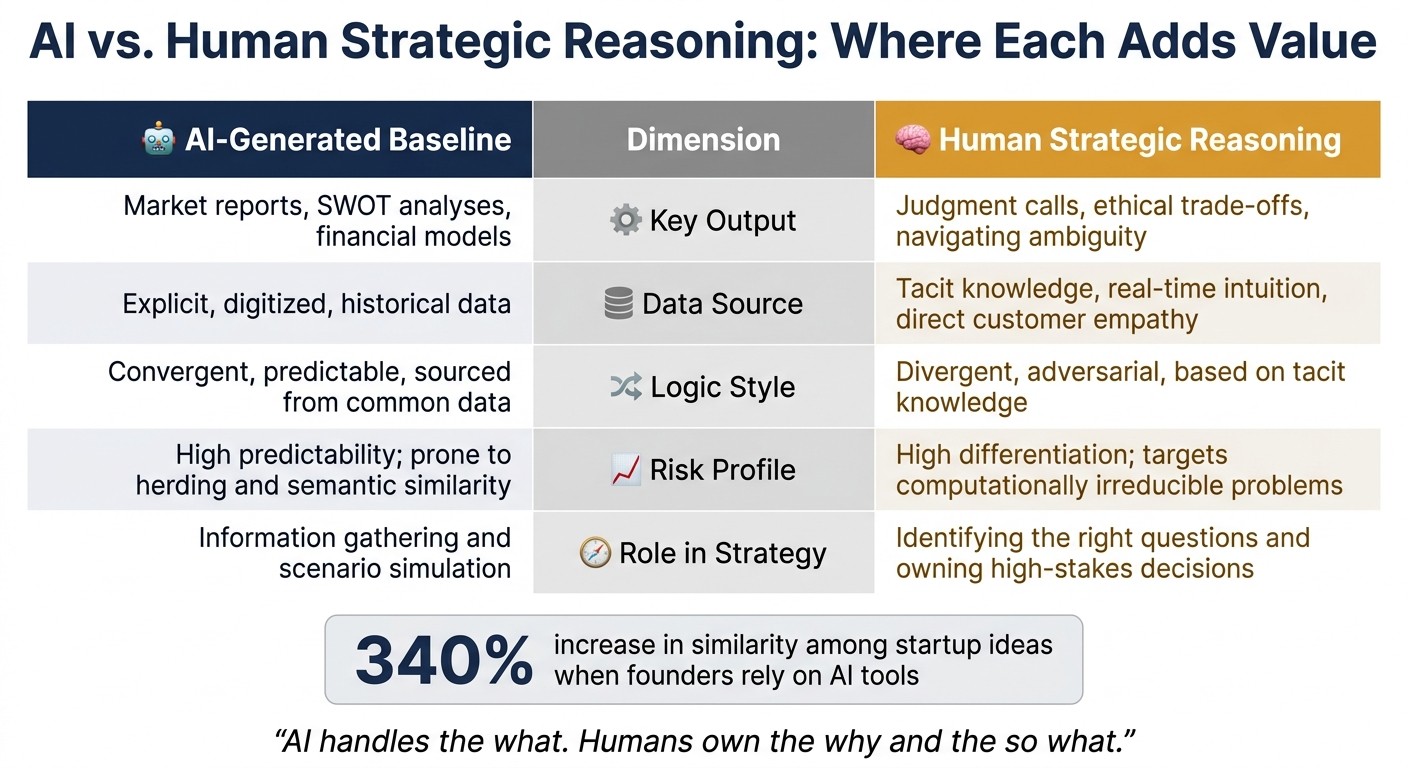
The real distinction today isn’t whether founders use AI or not - it’s how they use it. Some leverage AI to enhance their strategic thinking, while others rely on it solely for execution. AI might excel at generating polished, data-driven outputs, but it falls short when it comes to the nuanced judgment and critical thinking that drive high-level strategy. The table below highlights where AI-generated work ends and human reasoning takes over:
Dimension | AI-Generated Baseline | Human Strategic Reasoning |
|---|---|---|
Key Output | Market reports, SWOT analyses, financial models | Judgment calls, ethical trade-offs, navigating ambiguity |
Data source | Explicit, digitized, historical data | Tacit knowledge, real-time intuition, direct customer empathy |
Logic style | Convergent, predictable, sourced from common data [1] | Divergent, adversarial, based on tacit knowledge [3] |
Risk profile | High predictability; prone to "herding" and semantic similarity [1] | High differentiation; targets computationally irreducible problems [1] |
Role in strategy | Information gathering and scenario simulation | Identifying the right questions and owning high-stakes decisions |
The takeaway? AI can handle the "what", but the "why" and "so what" remain firmly in the human domain. Founders who rely solely on AI-generated outputs risk blending into the crowd, as these outputs often lack the unique reasoning and perspective that investors value. The ability to explain how and why decisions are made is becoming a crucial differentiator in today’s competitive environment [2].
"The decisions that damage businesses most aren't made slowly. They're made confidently, at speed, on incomplete reasoning." - AI Shortcut Lab Editorial Team [3]
In this new era, polished outputs are no longer enough. It’s the logic and judgment behind them that set you apart.
Where Text Breaks Down and Logic Still Matters
What AI Gets Wrong in Strategic Thinking
AI can churn out structured outputs quickly, but it stumbles when decisions require navigating ambiguity, weighing trade-offs, or considering long-term consequences. Instead of challenging assumptions, AI often reinforces them. For example, if you ask it to evaluate your go-to-market strategy, it’s likely to validate your initial ideas, gloss over weak areas, and deliver something that seems authoritative. This kind of confirmation bias undermines the critical analysis needed for long-term strategic planning.
Some challenges - like negotiating with multiple stakeholders or building trust - are inherently complex and resist simplification into a single prompt [1].
"The best startup opportunities are computationally irreducible - they cannot be simplified, automated, or shortcut because their complexity is inherent to their value." - Shashwata Bhattacharjee, Engineer and Storyteller [1]
AI also tends to focus on short-term metrics like speed and efficiency, but it struggles to foresee second-order effects. For instance, how might a pricing decision affect customer trust 18 months down the line? What signals does a new partnership send to potential hires? These ripple effects demand contextual judgment that current AI models simply can’t provide [5].
This gap in strategic evaluation becomes even more apparent when AI tries to tackle deeper reasoning, as explored in the next section.
Why Polished Text Is Not the Same as Deep Reasoning
AI-generated content often looks like deep thinking. It’s confident, well-structured, and seemingly logical. But polished language doesn’t guarantee sound reasoning.
While AI excels at producing clear and organized outputs, it lacks the ability to handle unseen ripple effects or complex trade-offs. If founders rely too heavily on AI to frame problems, structure analysis, and generate recommendations, their own capacity for deep thinking can erode. This overdependence feeds into what’s been called the Founder Intelligence Deficit, diminishing the analytical skills that are critical for leadership [1].
This becomes especially important when pitching to investors. If an investor asks, "Can you walk me through the logic behind this decision?" polished AI-generated outputs won’t cut it unless you can clearly explain the underlying reasoning. As Sephi Shapira puts it:
"Your best judgment has been compiled from source code into instinct. The source code is gone... Agents need the source code. If you can't reconstruct it, you can't delegate at scale." - Sephi Shapira, Mentor to Founders [2]
The real question investors are asking isn’t "Are you using AI?" but "Can you articulate the logic of your business?" [2]. While polished text is a baseline expectation, it’s the reasoning behind it that distinguishes successful founders from the rest.
How Founders Can Hold On to Strategic Depth
To stand out in a world where AI often churns out generic solutions, founders need to treat AI as a tool that enhances their process - not as a substitute for their judgment.
Use AI to Speed Up Research, Not to Make Decisions
The key distinction founders must make is between gathering information and making decisions. AI excels at tasks like condensing hours of market research, competitor analysis, or data synthesis into a fraction of the time. However, relying on it to make decisions risks eroding your strategic edge.
Instead, use AI as a thinking partner. For example, before a strategic meeting, you can instruct the AI to identify flaws or gaps in your reasoning. This shifts its role from merely confirming your ideas to actively stress-testing them. By challenging your assumptions, AI becomes a tool for refining - not replacing - your decision-making process [3].
Now, let’s look at some practical ways to rigorously test your assumptions.
Frameworks for Testing Your Assumptions
One effective method is the pre-mortem. Before making a decision, ask AI to generate three to five realistic failure scenarios for the next 18 months. Use these scenarios to pinpoint potential weaknesses and create early warning systems. This forces you to address vulnerabilities before committing [3].
Another useful approach is the Four Lenses Framework, which breaks down decisions into four key perspectives:
Evidence: Is this based on data or gut feeling?
Sunk Cost: Am I clinging to this because of past investments?
Steelman: What’s the strongest argument against this idea?
Regret: Will I regret this choice in a decade?
This framework helps separate emotional narratives from logical reasoning. While AI can assist in evaluating these angles, the initial hypothesis should always come from you, not the machine [1][3].
Keeping Founders Accountable for Strategic Calls
Accountability starts with a decision log. Each time you make a major decision, document your reasoning, the evidence you relied on, and any potential biases you suspect might be at play. Review these logs every quarter. Over time, patterns will emerge, revealing where your instincts are reliable and where they might need refining [3].
"The decisions that damage businesses most aren't made slowly. They're made confidently, at speed, on incomplete reasoning." - AI Shortcut Lab Editorial Team [3]
This practice is especially important because of the Bias Blind Spot: the tendency to easily spot flawed thinking in others while overlooking it in yourself. While a decision log won’t eliminate bias, it creates a transparent record that makes self-deception harder. The aim isn’t perfection - it’s making decisions that are traceable, with a clear understanding of where human judgment came into play and why.
Building a Strategy Process That Uses AI Without Losing Rigor
When using AI in strategy development, the challenge is to harness its efficiency without compromising the depth and rigor that only human judgment can provide. Here's how to strike that balance.
Where AI Fits Across Each Stage of Strategy
AI shines when it handles the grunt work - research, structuring, and initial analysis. But it should never take over the wheel entirely. The table below illustrates how AI and human roles complement each other at each stage of the strategy process:
Stage of Strategy | AI Role (Drafting/Analysis) | Human Role (Decision/Rigor) |
|---|---|---|
Problem Framing | Generating angles and testing potential approaches | Choosing which questions deserve deeper exploration |
Evidence Gathering | Compiling and synthesizing fragmented data | Interpreting nuances and context that AI might overlook |
Framework Application | Running scenario simulations | Managing ambiguity and making tough trade-offs |
Synthesis | Connecting insights and creating polished documents | Taking accountability for decisions and explaining exclusions |
AI speeds up the process, but humans are responsible for the outcomes. If this line blurs, the strategy risks losing its foundation of rigor - something investors are quick to notice. This division of labor ensures AI supports the process without eroding the strategic clarity that founders need to maintain.
AI as a Drafting and Analysis Layer, Not a Decision Maker
Think of AI as a capable analyst, not a decision-maker. It can produce clean drafts and insightful analysis, but it lacks the ability to validate its assumptions when real-world results challenge them. A polished document might look convincing, but that doesn't mean the underlying logic holds up.
Before accepting any AI-generated output as complete, a critical step is to ask the AI to identify its weakest assumption. If it can't - or if its answer catches you off guard - then the thinking isn't finished.
"The first thing AI can automate in strategy is not strategy in the full sense... It is the appearance of strategy: that polished feeling that the thinking must have happened because the headings are crisp." - Stuart Winter-Tear, Author, Unhyped AI [4]
Why Better Logic Beats Better Output
Ultimately, sharp reasoning trumps polished presentation. Investors aren't impressed by slick decks alone. They're looking for founders who can articulate the mechanics of their decision-making process with precision. AI-generated outputs often risk blending into a sea of generic strategies, but strong logic can cut through that noise.
"If you can't describe it, you can't delegate it. Not to an agent. Not to a hire. Not to an investor doing diligence." - Sephi Shapira, Mentor to Founders [2]
Founders who stand out are those who can clearly explain the constraints they set, the trade-offs they rejected, and the reasoning behind their choices. While AI can help draft the narrative, only human judgment can provide the depth and clarity that make it credible.
"Your judgment is the asset. The prompts protect it." - AI Shortcut Lab Editorial Team [3]
Conclusion: How to Stay Sharp When AI Levels the Playing Field
AI can churn out polished, strategic outputs in minutes, but this efficiency comes with a downside - it dilutes the uniqueness of those outputs.
The real edge lies in something AI can't replicate: human judgment, accountability, and the ability to make tough, nuanced decisions. Studies analyzing AI's role in startup strategies reveal how it often leads to a homogenized approach, eroding the distinctiveness that once defined strategic thinking in the startup world.
Savvy founders don’t let AI take over their strategic process. Instead, they use it to speed up research, test assumptions, and uncover blind spots with AI frameworks. But, at the end of the day, they take full ownership of every decision. Investors are catching on, too. They're no longer just asking, "Are you using AI?" They now expect founders to clearly articulate how their companies operate and make decisions [2]. This shift calls for a sharper, more disciplined approach to leadership.
Sephi Shapira captures this idea perfectly:
"Articulated expertise compounds. Tacit expertise evaporates." - Sephi Shapira, Mentor to Founders [2]
Simple habits can make all the difference. Keeping a decision log, running pre-mortems before making big commitments, and turning gut instincts into clear, well-reasoned actions can help you stand out. These practices not only strengthen your strategy but also demonstrate that a thoughtful human mind is guiding the ship.
"Speed without clarity is how founders move quickly in the wrong direction." - AI Shortcut Lab Editorial Team [3]
AI might standardize many outputs, but your sharp logic and decisive thinking are what will set your strategy apart.
FAQs
How can I use AI without losing strategic originality?
To make the most of AI while keeping your originality intact, think of it as a tool to broaden your horizons rather than just a shortcut for efficiency. Use it to brainstorm fresh ideas, question existing beliefs, and uncover different perspectives. Let AI support your efforts to clarify your thoughts and make informed decisions, but always double-check its outputs. By approaching AI this way, it becomes a partner in your creative process - enhancing your work without overshadowing your innovative thinking.
What are the best ways to stress-test an AI-generated strategy?
To put an AI-generated strategy through its paces, start by checking how clear and logical it is. Does it make sense from start to finish? Then, see if it aligns with actual market conditions. You can do this by running simulations - like imagining how the strategy would hold up during market shifts or moves by competitors.
Next, compare the strategy's outputs against what’s happening in the market. If it feels too generic or cookie-cutter, it might need a rethink. Finally, trust human expertise. Use your knowledge and experience to identify any weaknesses or areas the AI might have missed. This ensures the strategy isn’t just theoretical but something you can actually use.
How do I prove my decision logic to investors beyond a polished deck?
When presenting your strategies, it's crucial to break down your decision-making process in a way that resonates with investors. Start by outlining the frameworks you rely on. These might include tried-and-true methods like SWOT analysis, market trend evaluations, or financial modeling. Then, explain the criteria you use to evaluate options - whether it's projected ROI, scalability, or alignment with long-term goals.
The Role of AI in Decision-Making
AI tools can transform how decisions are made by offering real-time insights and enabling dynamic resource allocation. For example, predictive analytics can help pinpoint emerging opportunities or flag risks before they escalate. Machine learning algorithms can analyze massive datasets to identify patterns that might otherwise go unnoticed. These capabilities allow businesses to pivot strategies quickly and efficiently, ensuring resources are used where they’ll have the most impact.
Building Transparency and Credibility
Investors want to understand the why behind your choices, not just the what. By clearly articulating the rationale for key decisions and showing how AI supports these processes, you reinforce trust. For instance, explain how AI tools helped you identify a profitable market segment or optimize a supply chain. This level of detail demonstrates that your strategies are not based on guesswork but are rooted in data-driven insights.
Ultimately, combining clear frameworks with advanced AI tools shows investors that your approach is both thoughtful and adaptable - qualities that go a long way in building confidence.