Best AI Demand Forecasting Tools for Consultants
Compare top AI demand forecasting tools, accuracy gains, time savings, and selection tips for consultants.
Best AI Demand Forecasting Tools for Consultants
Key Takeaways:
AI reduces forecasting time by 35–50%, freeing up 10–15 hours per week for billable work.
Accuracy improves with 90–95% precision, compared to 65–79% for older methods.
Top tools include Forecast Pro, H2O.ai, SAP Analytics Cloud, Amazon Forecast, and StratEngineAI.
Why It Matters:
Clients now expect forecasts based on real-time data and reliable sources.
AI tools streamline workflows, integrate with planning frameworks like SWOT, PESTLE, and OKRs, and handle large datasets.
Tools like StratEngineAI cut proposal prep time from 48 hours to 2 hours, boosting profitability for consultants charging $200–$500/hour.
Quick Overview of Tools:
Forecast Pro: Best for ease of use with accurate algorithm selection.
H2O.ai: Handles large datasets with custom models.
SAP Analytics Cloud: Real-time analytics for enterprise-level clients.
Amazon Forecast: Automated machine learning for diverse data inputs.
StratEngineAI: Converts forecasts into polished strategy briefs with built-in frameworks.
AI is no longer optional for consultants - it’s essential for staying competitive in 2026.
AI Demand Forecasting: Boost Accuracy, Protect Capital & End Guesswork in Manufacturing
sbb-itb-7250072
Why Consultants Need AI Demand Forecasting Tools
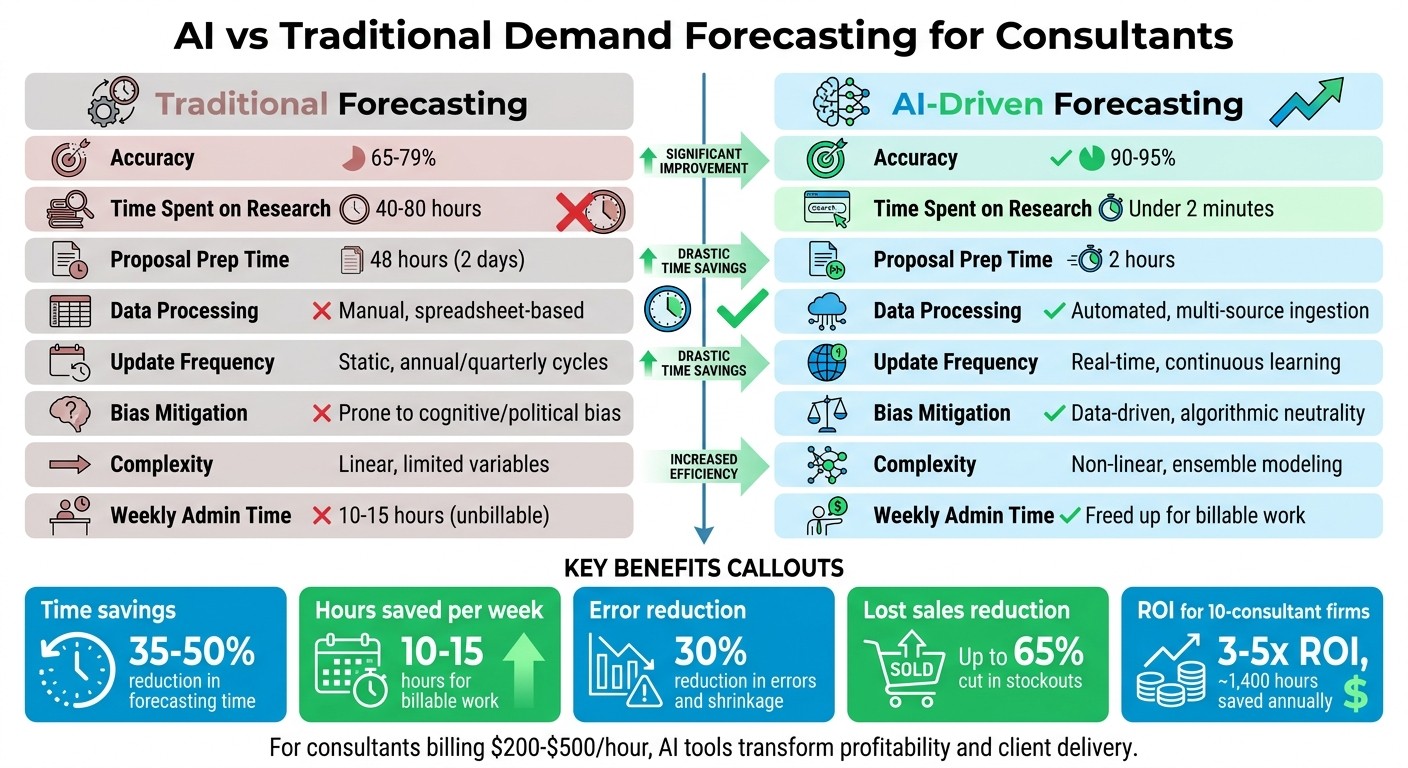
AI vs Traditional Demand Forecasting: Accuracy, Speed, and Efficiency Comparison
Boutique consultants work in an environment where accuracy, speed, and strategic precision are non-negotiable. Traditional forecasting methods - like spreadsheet models built on limited data and updated infrequently - often fall short of meeting client demands in today’s fast-paced market. AI demand forecasting tools address these gaps, improving profitability while tackling key challenges. These tools excel at delivering precise forecasts, saving time, and integrating seamlessly with established planning frameworks.
Improved Forecast Accuracy
AI algorithms are capable of uncovering intricate patterns and relationships within large datasets - patterns that human analysts might miss. Many advanced platforms use ensemble modeling, which combines techniques like decision trees, neural networks, and regression algorithms, to enhance both predictive accuracy and interpretability. This approach helps consultants identify market risks and scenarios that might otherwise go unnoticed due to biases or internal politics.
The numbers back this up. Retailers using AI for inventory and demand forecasting have reduced errors and shrinkage by 30%[8]. For consultants, this translates into more reliable recommendations, grounded in data rather than intuition. Unlike static models that only reflect historical trends, AI-powered systems continuously update using live data sources like SEC filings, news, and search trends[8].
"AI is most effective when paired with human judgment and contextual expertise." – The Strategy Institute[8]
Time Savings in Planning Workflows
AI tools deliver measurable efficiency gains, which directly impact profitability for consultants billing $200–$500 per hour. Tasks that once consumed hours - like reviewing 200-page data rooms - can now be completed in just 2–3 hours with AI-enhanced workflows[5]. Similarly, strategic analyses like SWOT, PESTLE, or TAM, which traditionally took 40–80 hours of manual research, can now be generated in under two minutes[3].
Take Strategy Consultant Mark L., for instance. He reduced his proposal preparation time from two days to two hours while also improving the visual quality of his deliverables[1]. AI tools also free up 10–15 hours per week previously spent on unbillable administrative work like meeting notes or contract reviews, allowing consultants to focus on high-value strategic tasks[6].
Beyond just saving time, these tools ensure that the data collected is structured and ready to integrate into established strategic frameworks.
Compatibility with Planning Frameworks
For data to be actionable, it needs to fit into a clear structure. Frameworks like SWOT, PESTLE, and Porter’s Five Forces turn AI-generated forecasts into organized, actionable matrices instead of overwhelming consultants with unstructured information[2][3]. This compatibility allows forecasts to seamlessly integrate into broader strategic planning processes that clients expect.
The concept of "living reports" highlights this integration. These dynamic documents automatically update as new market data, SEC filings, or competitor news become available[3]. Paired with established frameworks, these forecasts provide consultants with a constant stream of strategic insights rather than static snapshots.
Feature | Traditional Forecasting | AI-Driven Forecasting |
|---|---|---|
Data Processing | Manual, spreadsheet-based | Automated, multi-source ingestion |
Update Frequency | Static, annual/quarterly cycles | Real-time, continuous learning |
Bias Mitigation | Prone to cognitive/political bias | Data-driven, algorithmic neutrality |
Complexity | Linear, limited variables | Non-linear, ensemble modeling |
"It's like having a strategy team on demand. I can build client-ready frameworks before my next call even ends." – Daniel P., Managing Partner[1]
The key is using AI tools that cite their data sources, ensuring that client recommendations are always defensible[2][4]. By combining tools for data gathering, framework structuring, and stress-testing strategies[2], consultants can seamlessly incorporate demand forecasts into the deliverables their clients value most. This functionality becomes even more apparent when exploring AI platforms tailored specifically for consulting workflows.
Best AI Demand Forecasting Tools for Consultants
AI forecasting tools simplify demand analysis by automating complex processes like model selection and real-time data integration. This allows consultants to concentrate on delivering strategic insights. These tools are designed to meet the growing demand for precision and speed in forecasting, making them essential for modern consulting practices. Each tool on this list highlights efficiency and depth, reflecting the shift toward AI-enhanced consulting.
Forecast Pro
Forecast Pro is known for its "best pick" algorithm, which leverages AI and machine learning to select the most accurate forecasting method - whether it’s exponential smoothing, ARIMA, or neural networks. It’s ideal for consultants who need dependable results without requiring advanced data science expertise. Implementation is quick, often taking just hours or days instead of weeks [9].
H2O.ai
H2O.ai delivers enterprise-grade machine learning capabilities, excelling at processing large datasets to identify non-linear relationships and market trends that traditional models might overlook. Its adaptability allows consultants to create custom models tailored to specific industries or market conditions. This makes it particularly valuable for boutique firms handling a range of client needs.
SAP Analytics Cloud
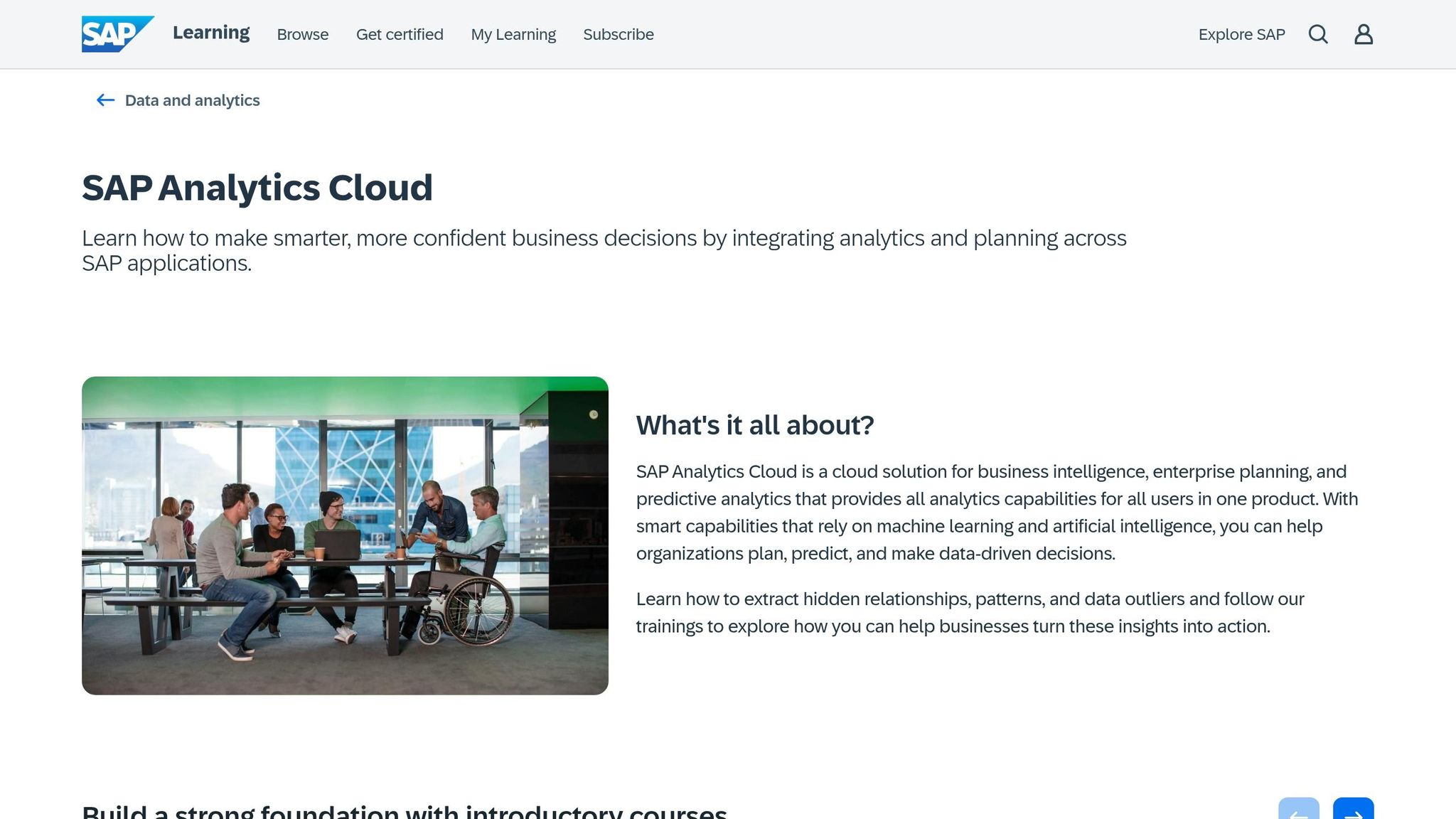
SAP Analytics Cloud offers real-time analytics via a cloud-based platform, making it a strong choice for enterprise-level forecasting. With live data feeds, consultants can provide forecasts that reflect current market dynamics rather than outdated snapshots. For firms working with large corporate clients already using SAP systems, the platform’s seamless integration supports scenario modeling and demand planning across multiple business units.
Amazon Forecast
Amazon Forecast uses automated machine learning to analyze diverse data sources without requiring manual feature engineering. It can process everything from historical sales data to weather patterns and economic indicators, automatically identifying the most relevant variables for accurate predictions. This makes it an excellent tool for scenario planning, enabling consultants to model multiple "what-if" scenarios and focus on delivering actionable recommendations.
StratEngineAI
StratEngineAI goes beyond standalone forecasting by embedding AI-driven projections into complete strategy briefs. With over 20 proven frameworks like SWOT, Porter’s Five Forces, and Blue Ocean Strategy, it transforms raw data into polished, client-ready deliverables.
The platform significantly reduces proposal preparation time - from 48 hours to just 2 hours - while enhancing the quality of outputs. StratEngineAI offers a free trial with limited demo slots, making it appealing for consultants charging $200–$500 per hour. By producing structured, framework-driven strategy briefs in minutes, consultants can increase profitability and deliver evidence-backed recommendations [1].
These tools showcase how AI-powered forecasting not only improves prediction accuracy but also enhances strategic decision-making, turning raw data into actionable insights for clients.
How to Select AI Demand Forecasting Tools
When choosing AI demand forecasting tools, focus on three key areas: accuracy, workflow integration, and scalability. A poor choice could lead to delays, fragmented data, and unreliable forecasts. To avoid these pitfalls, run a pilot test on a specific SKU mix before committing to a platform. This test will help ensure the tool meets a 90%+ accuracy standard and aligns with your workflow needs [11].
Forecast Accuracy and Reliability
Accuracy is the foundation of reliable forecasting. Traditional methods like ARIMA typically achieve accuracy rates between 65–79%, whereas AI tools consistently deliver 90–95% accuracy [11][12]. Only 7% of companies using traditional approaches manage to exceed 90% accuracy [11]. For consultants, this difference is critical - AI-driven forecasts can cut lost sales and stockouts by as much as 65% [11].
Opt for tools with explainable AI to foster trust. Clients need more than just numbers; they need to understand how forecasts are generated. Tools that operate as "black boxes" can undermine confidence, especially when making significant decisions about inventory or market entry timing [11][13]. Additionally, assess how well the tool handles new products with no historical data. The best platforms use machine learning to identify patterns from similar products, allowing accurate forecasts for new SKUs - a vital feature for product launches or portfolio expansions [11].
Look for features like automated outlier alerts to flag anomalies, enabling consultants to focus on high-priority issues instead of routine checks [10]. Tools with human-in-the-loop functionality allow consultants to adjust AI predictions based on market-specific insights, combining the strengths of automation with human expertise [11].
Integration with Existing Workflows
Smooth integration is key to avoiding inefficiencies and data silos. A modular approach often works best: use separate tools for research, structured frameworks (e.g., StratEngineAI), and validation [2]. This strategy ensures you can leverage the strengths of specialized platforms without overburdening a single tool.
For firms heavily reliant on specific ecosystems, native integration is a must. For example, teams using Microsoft 365 can benefit from tools like Microsoft 365 Copilot, which seamlessly connects with Teams, SharePoint, and Excel to keep data centralized [4][7]. Similarly, platforms that integrate with CRM and ERP systems eliminate redundant data entry and keep forecasts aligned with real-time business operations [4].
Ensure the tool supports strategic frameworks such as SWOT, PESTLE, or Porter's Five Forces. Modern AI tools can map forecast data to these frameworks automatically, saving time and delivering client-ready insights without extra formatting [1][2]. A well-integrated tool not only streamlines workflows but also sets the stage for broader deployment across projects.
Scalability Across Projects
Scalability determines whether the tool can grow alongside your consulting practice. Choose platforms with multi-model flexibility, offering access to advanced AI models like GPT or Gemini. This adaptability allows you to address a range of project needs, from financial modeling to detailed qualitative analysis [5]. For large-scale projects, ensure the tool can handle massive datasets - models with token windows exceeding 1 million are ideal for synthesizing extensive industry data [5].
API access is another crucial feature. It allows for automation by integrating forecasting tools directly into client systems, reducing manual work as project volumes increase [2]. Additionally, no-code platforms enable consultants to deploy predictive analytics without requiring specialized data science expertise [8].
Before committing to a tool, evaluate its implementation timeline. Enterprise-level platforms may take 6 to 12 months to roll out, while mid-market options can often be implemented in just 6 to 10 weeks [11][12]. Consider whether the tool offers SOC 2 certification and data residency options, especially for clients in regulated industries like healthcare or finance [4]. Start with a high-impact use case, such as proposal preparation or data cleaning, to demonstrate ROI before expanding usage firm-wide [4]. Efficient scaling transforms AI capabilities into consistent value for your clients.
Future Trends in AI Demand Forecasting
Demand forecasting is shifting from static models to dynamic, real-time systems. By 2026, the focus has expanded beyond single-point predictions to models that account for uncertainty through evidence-backed probability distributions [14]. This evolution is critical for consultants, as clients increasingly expect forecasts that include multiple scenarios and clear confidence intervals rather than just a single number. By 2025, 88% of organizations were using AI in at least one business function, while 59% of consulting firms globally had adopted generative AI for predictive modeling and strategy [7]. These advancements allow consultants to provide scenario-based insights that guide smarter strategic decisions.
Probabilistic Forecasting
Two key trends are reshaping forecasting, with probabilistic forecasting leading the way. Instead of relying on a single-number prediction, this approach uses probability distributions to capture uncertainty. Modern AI tools now deliver forecasts with confidence intervals, enabling clients to make risk-adjusted decisions - especially vital when entering unfamiliar markets or launching products without historical data. Multi-model prompting techniques take this a step further. By generating independent forecasts from multiple AI models - such as those developed by Anthropic, OpenAI, and Google - and aggregating their probabilities, consultants can minimize individual model biases [14]. This method helps boutique consultants identify risks and scenarios that might otherwise be missed due to internal politics or cognitive biases [8].
Multi-Source Data Integration
Alongside uncertainty quantification, multi-source integration ensures forecasts are grounded in real-time market dynamics. AI tools now merge internal sales data with real-time inputs like multilingual news, market trends, policy updates, and social signals to improve accuracy [14][8]. This approach transforms forecasting from a retrospective analysis into a forward-looking intelligence tool. For instance, consultants can enrich demand forecasts by incorporating live policy changes, emerging market trends, and social sentiment data.
Swarm learning represents the forefront of this trend. Interconnected AI systems share insights across industries and companies in real time, significantly boosting predictive accuracy [8]. By late 2024, companies leveraging AI had outperformed traditional competitors on key metrics like revenue growth and customer retention [8]. As Jamie, a Business Strategist, succinctly put it:
"AI didn't just change the game - it flipped the board" [8].
For consultants, these innovations refine risk assessments and strengthen competitive positioning. By embracing these advancements, boutique consultants can turn raw data into actionable intelligence, meeting the evolving expectations of modern clients.
Conclusion
The rise of AI forecasting has transformed the way boutique consulting firms approach strategic planning. These tools are now indispensable for delivering precise, actionable insights while navigating tight deadlines and limited resources. For smaller firms with around 10 consultants, the payoff is undeniable - AI tool stacks can deliver an estimated 3–5x ROI, saving approximately 1,400 hours each year [7]. This underscores how central AI has become in driving modern consulting excellence.
The right AI tool doesn't just assist - it reshapes workflows entirely. Real-world examples highlight significant time savings, allowing consultants to shift their focus from tedious administrative tasks to building stronger client relationships and refining strategic solutions.
Choosing the best AI forecasting platform involves weighing factors like forecast accuracy, seamless workflow integration, and ability to scale. Platforms such as StratEngineAI meet these demands by offering over 20 strategic frameworks and automated deliverable generation. This means consultants can transition directly from client discussions to polished, ready-to-share presentation decks in no time [1]. With 88% of organizations already using AI in at least one business function and 59% of consulting firms globally adopting generative AI for predictive modeling [7], the competitive landscape has been fundamentally reshaped.
Looking ahead, success in 2026 won’t just hinge on adopting AI; it will depend on using it ethically and strategically. As one industry expert aptly put it:
"The competitive edge in 2026 is not which tool you use. It is whether your clients trust that you use it responsibly" [7].
For boutique consultants, the message is clear: leverage AI-powered forecasting tools to elevate your expertise, safeguard client data with robust security measures, and deliver the high-quality analysis that top executives demand.
FAQs
What data do I need to start AI demand forecasting?
To get started with AI demand forecasting, the first step is collecting structured, high-quality data for analysis. This data should cover essentials like market size, customer demand signals, the competitive landscape, and historical sales or usage figures. By analyzing this information, AI can uncover patterns and produce reliable predictions. The key to accurate forecasting lies in making sure your data is well-organized and directly relevant to your goals.
How can I validate AI forecasts before sharing them with a client?
To ensure the reliability of AI forecasts, it's essential to take a structured approach. Start by comparing the predictions with historical data, external market trends, and recent outcomes. Regular performance testing is key - evaluate the model regularly and make adjustments where necessary. Using real-time data and refining the model consistently not only improves precision but also builds trust before sharing forecasts with clients. This method helps spot inconsistencies and enhances dependability over time.
How do I handle forecasting for new products with little or no history?
Forecasting demand for new products without historical sales data can feel like a guessing game, but AI tools make it much more manageable. These systems dive into external market trends, real-time data, and consumer behavior to fill in the gaps. Using predictive analytics, they uncover patterns and generate demand estimates, even when past sales figures are missing. By analyzing factors like competitor strategies and shifting market dynamics, AI models offer practical forecasts that guide decisions on inventory, pricing, and supply chain management.