
AI in Scenario Modeling for VCs
AI automates VC scenario modeling with real-time forecasts, multi-variable analysis, earlier risk detection, and faster due diligence.
Mar 31, 2026

AI is transforming how venture capital (VC) firms evaluate opportunities and manage risks. By automating scenario modeling, AI enables faster, more accurate decisions using real-time data and advanced analytics. Here’s what you need to know:
Traditional challenges: Manual scenario modeling is slow (40–60 hours per deal), relies on static data, and often misses key insights due to fragmented systems.
AI solutions: AI centralizes data, continuously updates forecasts, and analyzes hundreds of variables simultaneously. It detects financial stress 2.3 months earlier than traditional methods and allows firms to review 3–5x more opportunities.
Key benefits: Faster deal evaluations (10–14 days vs. 4–6 weeks), improved risk assessment (27–30% better risk-adjusted returns), and early detection of operational issues like hiring trends or revenue inconsistencies.
Practical tools: Platforms like StratEngineAI streamline workflows, automate data analysis, and provide traceable insights for investment committees.
AI-powered scenario modeling isn’t just a tool - it’s becoming essential for staying competitive in fast-paced VC markets.
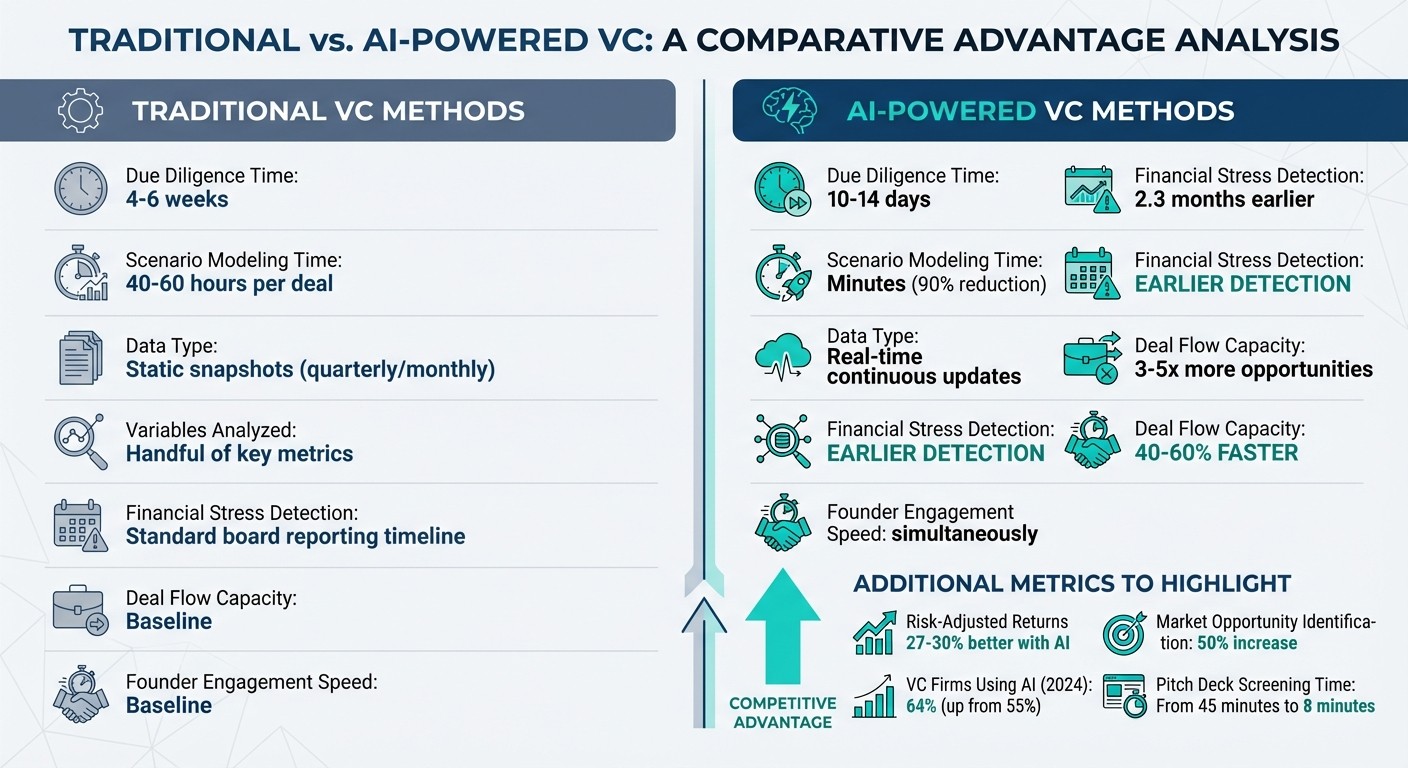
Traditional vs AI-Powered VC Scenario Modeling: Key Performance Metrics
How AI Improves Scenario Modeling for VCs
Real-Time Forecasting with AI
Traditional scenario modeling often relies on static snapshots - quarterly or monthly reports that quickly lose relevance. AI changes the game by pulling in real-time data through APIs connected to platforms like Stripe, QuickBooks, and CRMs, enabling continuous updates to forecasts [2][1]. As new data flows in, projections automatically adjust, ensuring forecasts remain up-to-date. This proactive approach allows AI to spot potential issues as they arise, rather than waiting for periodic reviews to uncover them.
And it doesn’t stop there. While traditional methods focus on lagging indicators like revenue, AI also tracks leading signals - things like GitHub code commits, patent filings, and hiring trends - that can provide early insights into a company's future performance [2]. This constant stream of data helps AI identify operational trends that might otherwise go unnoticed.
Finding Hidden Patterns and Variables
Human analysts tend to zero in on a handful of key variables, but AI can process hundreds at once, uncovering subtle relationships that might escape notice [4]. For example, it might detect how certain executive hiring decisions during growth phases align with a company’s long-term success [4][2].
Top venture firms are already employing specialized AI agents for different types of analysis. One agent might ensure consistency across data rooms, while another tests assumptions against external factors, like labor market trends. A third could even analyze sentiment in founder interviews [3]. These systems can create "contradiction maps" - visual tools that highlight discrepancies, such as mismatches between a startup's financial projections and market realities or inconsistencies between founders' claims and actual contract data [3]. For instance, AI might flag a gap between reported annual recurring revenue and metrics like web traffic or cloud infrastructure spending, raising red flags that manual reviews might overlook.
Building AI-Powered Scenario Models for VC
The 3 Core Scenarios: Base, Bull, and Bear Cases
Venture capital (VC) scenario models typically revolve around three projections: the base case (the most likely outcome), the bull case (a more optimistic scenario), and the bear case (a downside scenario). AI takes these traditional models a step further by simulating detailed liquidity paths for each case, predicting not just outcomes but also their timing [5]. What sets AI apart is its ability to continuously update these scenarios as new data flows in, ensuring that projections are always aligned with the latest market trends.
One of the standout capabilities of AI is stress-testing assumptions against real-world conditions. For example, it can compare a startup's projected burn rates against current cloud computing costs or evaluate hiring plans in light of the latest labor market data [3]. This ensures that scenario models are grounded in reality, avoiding outdated or overly optimistic operational assumptions.
Key Variables for VC Scenario Modeling
Once the scenarios are established, identifying the right variables becomes essential for refining projections. AI excels at this by pulling in data from a variety of sources - like QuickBooks, Stripe, or even custom spreadsheets - and standardizing it for analysis. A technique called multi-agent diligence comes into play here. Different AI agents specialize in specific tasks: one might analyze data rooms for internal consistency, another could validate assumptions by comparing them to external market conditions (e.g., assessing hiring plans against labor market trends), and a third might evaluate founder sentiment [1][3]. These agents work simultaneously, generating a comprehensive analysis in a fraction of the time it would take a human team.
Advanced Scenario Modeling Applications
Beyond basic projections and variable analysis, advanced AI techniques allow for even deeper insights. Through contradiction mapping, AI identifies inconsistencies by cross-checking financial projections with earlier versions or comparing customer claims to actual contracts and technical documentation [3]. This process can uncover red flags, such as overly ambitious growth targets or mismatched go-to-market strategies.
"The new advantage lies in signal velocity - not who meets a founder first, but who detects movement first." - Ivelina Dineva, Author, GoingVC [3]
AI is also reshaping how VCs approach startup staffing and spending. The trend toward "lean team strategies" - where startups achieve critical milestones with fewer employees - has led to a shift in how capital is allocated. Instead of relying on historical staffing costs, AI helps align funding with the actual cost of achieving specific learning objectives [3]. By integrating these advanced techniques, VCs can build more precise scenario models that reflect the realities of today’s startup ecosystem, ultimately improving deal evaluation and investment outcomes.
Benefits of AI Scenario Modeling in VC Deal Evaluation
Faster Decisions in Competitive Markets
In venture capital, speed often determines who wins the deal. Traditional due diligence processes can take 4–6 weeks, but AI-powered scenario modeling slashes this timeline to just 10–14 days [1]. This quicker turnaround is crucial in competitive markets, allowing firms to engage with founders 40–60% faster than their rivals [2].
By adopting AI-driven sourcing, firms can evaluate 3–5 times more qualified opportunities compared to relying solely on traditional networks [2]. This capability not only boosts deal flow but also ensures that VCs maintain the same level of analytical rigor. The result? A significant advantage in both speed and depth of evaluation, turning what was once a bottleneck into a competitive strength.
Better Accuracy and Risk Assessment
AI enhances the reliability of forecasts by analyzing datasets too large for manual methods. For example, Natural Language Processing (NLP) tools can reduce financial modeling time by 90%, all while improving precision [6]. These tools also identify subtle red flags, such as shifts in CEO sentiment or unusual revenue patterns, that might go unnoticed otherwise [6].
When it comes to portfolio management, AI delivers measurable results. Firms leveraging AI have seen a 27–30% improvement in risk-adjusted returns compared to traditional approaches [6]. Similarly, investment banks using AI for trend analysis report a 50% increase in identifying market opportunities early [7]. Machine learning models further enhance decision-making by simulating thousands of "what-if" scenarios. These simulations test variables like interest rate fluctuations or market downturns, replacing static assumptions with dynamic probability-based insights [6]. This level of accuracy enables more proactive and informed risk management.
Early Risk Detection and Management
AI models act as early warning systems, identifying potential issues well before they escalate. On average, these systems detect financial stress in portfolio companies 2.3 months earlier than traditional board reporting methods [2]. This early insight gives VCs the chance to take preemptive action - whether that means adjusting spending, shifting strategies, or securing additional funding.
But AI doesn’t stop at financial metrics. It also monitors operational indicators, such as changes in hiring trends or key employee departures, often flagging issues weeks before they become apparent in board discussions [1]. By late 2024, 64% of VC firms were using AI tools for research and due diligence, up from 55% the previous year [1]. This growing adoption highlights the practical benefits AI offers in mitigating risks and shifting from reactive to proactive portfolio management.
Adding AI Scenario Modeling to VC Workflows
Preparing Your Data for AI Modeling
Clean and well-organized data is the backbone of effective AI scenario modeling. Before introducing AI into your workflow, take the time to audit and consolidate historical deal records that may be scattered across different systems. For more expert tips and business innovation guides, consult our latest strategy resources.
Start with data normalization. Portfolio companies often report financials in various formats - QuickBooks files, Stripe dashboards, or custom spreadsheets. AI systems can process these diverse sources and map them to a unified taxonomy, making it easier to compare performance across your portfolio [1]. However, this process only works if you establish robust source verification from the beginning. Every data point should trace back to reliable sources like audited financial reports, regulatory filings, or authenticated API feeds. Data lineage is equally important: if an AI model flags a potential risk or generates a specific scenario, you need to pinpoint the exact document or metric that influenced the outcome. Regular bias audits on AI outputs can help ensure that the system doesn’t unintentionally undervalue nontraditional founders or miss opportunities in emerging markets.
Once your data is standardized and verified, the next step is to integrate it into your decision-making processes seamlessly.
Connecting AI Outputs with VC Decision Processes
After ensuring your data is reliable, focus on embedding AI outputs into your venture capital workflows. Consolidate financial, operational, and market data into a single, trusted system to generate actionable insights for investment committee (IC) members [4]. Identify key drivers such as customer acquisition cost (CAC), churn rate, and total addressable market (TAM) to anchor your investment decisions [4]. To streamline operations, connect systems via APIs, enabling real-time data synchronization.
Forward-thinking firms are shifting the focus of IC meetings. Instead of reviewing narratives, they now stress-test AI-generated contradiction maps and scenario assumptions. These sessions challenge the model's outputs, exploring where it might be flawed [3]. Additionally, limited partners (LPs) increasingly expect more dynamic reporting. Instead of static quarterly PDFs, they want interactive dashboards that allow real-time queries and deeper insights [3].
Using StratEngineAI for Scenario Modeling
StratEngineAI simplifies the complex process of VC scenario modeling. The platform automates tasks like pitch deck screening, generating traceable investment memos, and verifying strategies - all while delivering high-quality analysis. This speed is crucial in competitive markets, where quick decisions can make all the difference.
StratEngineAI incorporates over 20 strategic frameworks, such as SWOT, Porter's Five Forces, and Blue Ocean Strategy, to power its scenario analysis. What used to take weeks can now be done in minutes, allowing firms to evaluate 3–5 times more opportunities without sacrificing thoroughness [2]. The platform also ensures transparency by linking scenario outputs directly to the underlying data points, meeting the high standards of both IC members and LPs.
For firms hesitant to dive in completely, StratEngineAI offers a free trial. Teams can upload specific challenges and generate strategy decks, making it easy to test the platform’s capabilities. A phased approach - starting with targeted use cases like quarterly revenue forecasting or annual budget planning - can help firms explore its potential before committing to a full rollout [4].
The AI Future of VC - Venture Underground Ep 4
Conclusion
AI scenario modeling is reshaping how venture capital (VC) firms evaluate opportunities and manage risk. Instead of depending on static spreadsheets or quarterly updates, VCs now benefit from real-time insights that can identify financial stress an average of 2.3 months earlier [2]. This early warning system, paired with the ability to simulate multiple liquidity paths with confidence intervals, equips firms to handle uncertainty with greater accuracy.
AI also streamlines deal screening processes. Firms leveraging AI-driven sourcing tools review 3–5 times more qualified opportunities while slashing screening times from 45 minutes to just 8 minutes [2]. Standardized scoring systems and traceable memos further ensure that decisions rely on objective data rather than subjective biases or personal connections.
By late 2024, 64% of VC firms had adopted AI tools for research and due diligence [1], marking a definitive shift toward data-driven strategies. Firms that embrace AI scenario modeling now position themselves to excel in fast-paced markets, where timely decisions can make or break a deal.
For VC teams looking to modernize their workflows, StratEngineAI offers a free trial. This tool allows teams to upload challenges and generate strategy decks in minutes - tasks that previously took weeks - while maintaining the rigor demanded by investment committees and limited partners.
FAQs
What data is needed to start AI scenario modeling?
To kick off AI scenario modeling, start by gathering data on the startup's current trajectory, including its growth trends and key performance indicators. Combine this with insights into market conditions, the competitive landscape, and the company's financial health. Don’t forget to account for potential future variables, such as market downturns or shifts in demand. Together, this information forms the foundation for creating realistic and actionable scenarios.
How can we validate AI forecasts and avoid bias?
To ensure AI forecasts are reliable and reduce bias in venture capital scenario modeling, it's crucial to rely on objective, data-driven methods. Here are some effective strategies:
Use predictive models and consistent risk scoring systems: These tools help standardize evaluations, making outcomes less prone to subjective human errors.
Incorporate scenario planning: Develop models that account for multiple outcomes - best-case, worst-case, and moderate scenarios - to better handle uncertainty.
Regularly update models with new data: Keeping your models current ensures they reflect the latest market conditions and trends.
Cross-validate predictions with real-world outcomes: Continuously compare AI-generated forecasts to actual results to identify gaps and refine the models.
By combining these practices, you can make AI-driven decisions more dependable while reducing the influence of human judgment errors.
How should AI outputs be used in investment committee decisions?
AI tools play a crucial role in supporting investment committee decisions by delivering data-driven insights, risk evaluations, and scenario analyses. These tools can objectively highlight potential outcomes, flag risks, and uncover opportunities.
That said, committees must balance AI-generated insights with their own market expertise, practical experience, and thorough due diligence. While AI can refine analysis and help minimize bias, the ultimate decisions should rest on human judgment. A structured decision-making approach ensures flexibility and alignment with broader strategic goals.